On this page
- Federally Regulated vs Provincially Regulated: Does This Apply to Your Contract?
- The Core Mechanics: What Equal Pay for Temporary Workers Actually Means
- Direct Hires vs Agency Contractors: How Parity Works Across Staffing Intermediaries
- The Legitimate Exceptions: When Pay Gaps Are Lawful
- 1. Seniority Systems
- 2. Merit Systems
- 3. Quantity or Quality of Production
- 4. Objective Geographic Differentials and Red-Circling
- Pay Equity vs Equal Pay: Clearing Up the Canadian Alphabet Soup
- Step-by-Step: How to Audit Your Own Wages as a Temporary Worker
- Step 1: Confirm Jurisdiction and Contract Entity
- Step 2: Document Your Actual Daily Work Scope
- Step 3: Identify Your Direct-Hire Comparators
- Step 4: Benchmark Against Public Labour Market Data
- Step 5: Check for Legitimate Pay Differentials
- The 90-Day Formal Wage Review Protocol: How to Request an Adjustment
- Delivering the Request
- The 90-Day Clock
- The Mandatory Written Response
- Legal Protection Against Reprisal
- Talking to Your Staffing Agency or Hiring Manager Without Burning Bridges
- Strategic Career Implications for Canadian Temporary Workers
- Transitioning from Contract to Permanent
- Stronger Starting Positions for New Contracts
- Building a Strong Documentation Trail
- In brief
- Key takeaways
- Frequently asked questions
On September 25, 2026, Employment and Social Development Canada put employers and staffing firms on formal notice by issuing updated enforcement guidelines under Part III of the Canada Labour Code regarding equal pay obligations. These directives provide real teeth to regulations taking full effect on October 20, 2026, under the federal Equal Treatment and Temporary Help Agencies framework. For years, Canadian operations in banking, logistics, and telecommunications leaned on third-party placement agencies and temporary contracts to cut overhead. In practice, that meant paying contract workers significantly less than permanent peers sitting in the very next cubicle. Under the updated directives, that compensation divide is illegal across all federally regulated private-sector employers.
If you work on a temporary contract, a fixed-term placement, or a third-party agency ticket in Canada, this policy shift directly affects how your compensation is legally evaluated. The federal rules mandate pay parity by employment status for comparable work. Employers can’t close the gap by slashing anyone else’s wages, and you have access to a formal 90-day review mechanism to challenge your hourly rate. Understanding the mechanics of these equal pay rules for temporary workers allows you to determine whether your position qualifies, evaluate your compensation against direct-hire benchmarks, and request an upward adjustment without jeopardizing your standing on the job.
Federally Regulated vs Provincially Regulated: Does This Apply to Your Contract?
Before looking at any labour code reform, you need to know which government writes the rules for your desk. Most Canadian labour law sits with the provinces. Roughly 90 percent of the country’s workforce falls under provincial or territorial statutes, like Ontario’s Employment Standards Act or the Alberta Employment Standards Code. Those provincial frameworks have had a bumpy run with pay parity. Ontario briefly introduced equal pay for equal work protections for temporary and agency staff under Bill 148 in 2018, only to roll most of them back under Bill 47 later that same year.
The updated rules from Employment and Social Development Canada apply to the remaining 10 percent of the workforce. That covers roughly 1.2 million workers across about 4,500 enterprises governed by Part III of the Canada Labour Code. Ten percent sounds modest, but the federal private sector employs a huge share of the country’s white-collar contractors, tech specialists, and warehouse staff.
Federal jurisdiction includes these sectors:
- Chartered banks such as RBC, TD, Scotiabank, BMO, and CIBC, including their back-office processing and technology divisions
- Telecommunications and broadcasting companies, including Bell, Rogers, Telus, and federally regulated internet and cable operations
- Interprovincial and international transportation, covering airlines like Air Canada and WestJet, marine shipping, and railways like CN Rail and CPKC
- Road transportation operations where trucking and bus routes cross provincial or international boundaries
- Postal and courier networks, including Canada Post, Purolator, and cross-border delivery logistics facilities
- Port operations, longshoring, marine terminals, and grain elevators
- Federal Crown corporations, such as Via Rail and Atomic Energy of Canada Limited
- First Nations band councils and certain Indigenous governance organizations
Your workplace jurisdiction comes directly from the client employer. If you work as an agency contractor placed inside an operations centre at a major bank in downtown Toronto, or as a temporary logistics handler at a rail terminal in Calgary, your workplace falls under federal rules. It does not matter if your staffing agency is a local agency registered provincially in Ontario or Alberta. The client facility where you do the work decides which code governs your rights. When choosing between contract vs full-time jobs in Canada, that difference determines whether the law gives you a statutory right to equal pay or leaves your rate to agency markups.
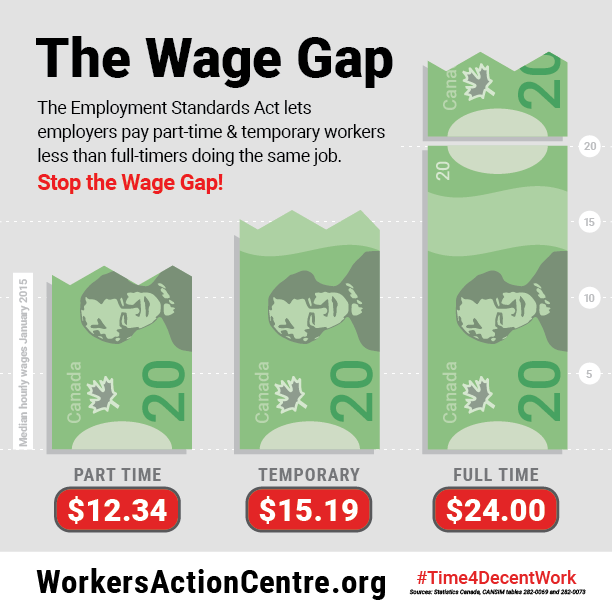
The Core Mechanics: What Equal Pay for Temporary Workers Actually Means
Sections 182.1 and 182.2 of the Canada Labour Code, along with ESDC guidelines IPG-122 and IPG-123, lay out a clear rule: an employer cannot pay you a lower wage rate simply because of your employment status, provided you and your peer do substantially the same work.
The regulations define employment status across four categories: permanent, temporary, full-time, and part-time. That temporary designation covers fixed-term contracts, casual workers, seasonal workers, and irregular shift staff. The rule applies across the board. An employer cannot give a permanent employee a higher base hourly rate merely because their position is ongoing while your contract comes with an end date.
The Canadian law firm MLT Aikins outlined the scope of this rule in a detailed legal analysis:
Under the Amendments, federally regulated employers will be prohibited from paying employees performing substantially the same kind of work at different wage rates based solely on their employment status, that is, whether they are employed on a full-time, part-time, permanent or temporary basis.
This parity requirement ignores superficial corporate titles and focuses directly on the daily tasks on the floor. To decide whether two employees must receive equal wage rates, the Canada Labour Code applies a four-part comparability test:
First, both workers must be employed in the same industrial establishment. Under federal regulations, an industrial establishment is defined by Employment Insurance economic regions. That means you do not have to share a physical building or sit at an adjoining desk. If you work at different branch locations or logistics yards within the same economic region, you satisfy the geographic test.
Second, you must perform substantially the same kind of work. The assessment looks past corporate job titles. If an employer labels your permanent colleague an “Associate Logistics Specialist” while calling your contract role an “On-Call Operations Assistant”, but both of you spend your days logging inventory in SAP and managing shipping manifests, the work is substantially the same.
Third, carrying out that work must demand substantially equal skill, effort, and responsibility. Skill covers formal education, trade certifications, physical dexterity, and practical experience needed to complete your duties. Effort takes in mental concentration as well as physical exertion. Responsibility looks at direct accountability, such as managing cash, overseeing equipment, or signing off on mandatory compliance checks.
Fourth, the work must take place under similar working conditions. Sitting inside an air-conditioned dispatch facility brings different conditions than working outdoors on a railway siding in minus-twenty-degree winter weather. If you and the permanent employee share the same physical environment, hazards, and shift patterns, your conditions are legally similar.
Finally, the comparison requires that wages share the same basic calculation structure. You compare an hourly worker to an hourly worker, a mileage-based long-haul driver to another mileage-based driver, and piece-rate workers to piece-rate workers. When all of these factors line up, paying the temporary worker a lower hourly rate is a direct violation of federal law.
Direct Hires vs Agency Contractors: How Parity Works Across Staffing Intermediaries
Agency markups have long eaten away at contract pay across Canada. Consider a typical placement: a bank or freight carrier contracts an agency for contingent labour, paying $45 an hour for data operations or administrative support. The agency turns around and pays you $24 an hour, pocketing the $21 spread as operating margin and profit. Meanwhile, the permanent employee sitting next to you doing identical work makes $34 an hour plus benefits.
You end up taking home $10 less per hour than your direct-hire peer, even though the client pays more than enough to cover parity. ESDC addressed this three-way setup directly in its updated IPG-123 guidance.
Under Section 182.2 of the Canada Labour Code, temporary help agencies in federally regulated sectors cannot pay placed workers less than the rate paid to the client’s direct staff performing substantially similar work. Clients cannot avoid liability by hiding behind third-party supplier agreements, either. Under federal regulations, clients must give their wage details to placement agencies so compliant parity rates can actually be calculated. In a review of the regulations, Vancouver-based law firm Alexander Holburn pointed out the broad reach of that requirement.
The rules also prevent employers from closing pay gaps in the wrong direction through what is known as the upward-only correction rule. If a client and an agency realize an agency office administrator or IT technician earns $22 an hour while direct staff earn $28, they cannot satisfy the Code by dragging permanent wages down to $25. The statute explicitly outlaws pay cuts to achieve compliance. The only lawful fix is raising the rate for the lower-paid worker.
Federal rules also ban recruitment and onboarding charges. Agencies operating in the federal jurisdiction cannot charge you fees for interview preparation, resume formatting, registration, or job placement. If an agency contract tries to dock your hourly pay for placement administration, the Code renders that clause void.
The Legitimate Exceptions: When Pay Gaps Are Lawful
Canadian labour policy still gives employers room to reward experience, performance, and productivity. Under the Canada Labour Code, wage gaps between permanent and temporary staff are lawful when they rest on objective, systematic criteria. Workers on the same shift do not automatically draw identical pay cheques.
The Code lays out four specific exceptions where an employer or staffing agency can pay different rates for substantially similar work:
1. Seniority Systems
Companies can run a formal pay scale based on length of service. Take CPKC: if a permanent rail dispatcher has eight years on the job and has climbed through annual step increases, their hourly wage can legitimately sit above a newly hired temporary dispatcher’s rate. That seniority structure has to be genuine, consistent, and applied across the board. An employer cannot manufacture seniority out of thin air to pay a contractor less when both workers walked through the doors three months ago.
2. Merit Systems
Pay can also vary through formalized merit and performance appraisals. When a business uses a structured evaluation process tracking output, error rates, and skill execution, strong performers can earn higher rates. Discretion cannot be arbitrary. A manager cannot point to a supposed merit difference without documented, clear metrics that were shared with the workforce ahead of time.
3. Quantity or Quality of Production
Where pay ties directly to measurable output (pieces processed, completed code modules, or sales metrics reached), wage differences are permitted. If two customer service agents work the same shift, for instance, and one closes more support tickets under an established incentive formula, their total earnings can reflect that spread.
4. Objective Geographic Differentials and Red-Circling
The Code ties baseline establishment rules to Employment Insurance economic regions, yet genuine cost-of-living allowances and geographic premiums between remote northern stations and southern urban centres remain valid. Red-circling is also allowed. When an experienced employee keeps a higher legacy wage after a corporate re-organisation, a health accommodation, or a demotion without fault, that frozen rate does not set a mandatory wage floor for incoming temporary workers.
Every single one of these exceptions hinges on written proof. A seniority, merit, or production system has to exist on paper, apply uniformly across comparable roles, and be made available in writing to any worker who asks to see it. If your employer defends a wage gap with a merit system that exists only in a manager’s head, that explanation will collapse under an ESDC inspection.
Pay Equity vs Equal Pay: Clearing Up the Canadian Alphabet Soup
Canadian employment law has two terms that get mixed up constantly: “pay equity” and “equal pay for equal work.” They sound interchangeable, but they tackle different workplace problems under completely separate rules.
Federal pay equity falls under the Pay Equity Act, which took effect in 2021 through the Canadian Human Rights Commission. Its goal is fixing systemic gender pay gaps by comparing entirely different jobs of equal organizational value. For instance, an employer evaluates whether a predominantly female job class, like an administrative coordinator, earns fair pay compared to a predominantly male job class of similar weight, like an equipment maintenance technician. This is a collective, systemic process that relies on internal committees, job evaluation scoring, and multi-year compensation plans.
Equal pay for temporary workers under Part III of the Canada Labour Code works as a direct, individual comparison based on employment status. It does not look at different roles. Instead, it compares two people doing the exact same work under identical working conditions to stop an employer from shortchanging an agency or contract hire simply because of how they were brought on.
Sophie Arseneault, a labour and employment partner at Fasken, outlined this distinction when speaking to Canadian HR Reporter:
To see how the Canadian Human Rights Commission compares roles and measures organizational value across federally regulated employers, this official overview outlines the framework:
Systemic pay equity reviews tackle broader historical gender divides over several years. The Canada Labour Code rules, on the other hand, give an individual temporary worker an immediate right to dispute their current hourly rate. Knowing that separation is essential when you bring up pay transparency in Canada with your employer, because each avenue comes with its own legal mechanisms, timelines, and solutions.
Step-by-Step: How to Audit Your Own Wages as a Temporary Worker
Before you raise a wage disparity with your manager or HR, gather your facts. Having verifiable comparison figures in hand protects your standing and keeps the discussion tied to concrete evidence rather than speculation.
Step 1: Confirm Jurisdiction and Contract Entity
Check your original contract paperwork and see which corporate entity signs your cheques. If you were hired directly, check whether that employer’s business falls under federal jurisdiction. If a staffing agency placed you, look straight past the agency to the client company where you do your daily tasks, whether on site or remotely. Whenever that host client is a chartered bank, an interprovincial transport firm, a telecommunications carrier, or a federal Crown corporation, you fall under Part III of the Canada Labour Code.
Step 2: Document Your Actual Daily Work Scope
Spend two weeks recording what you do on each shift. Recruiter job descriptions are often out of date or copied from an old template, so focus on the day-to-day reality. Keep track of:
- The software applications, enterprise databases, and equipment you use daily
- The volume of work you complete, including daily transactions and client interactions
- Your level of independence on the job, noting whether you work without supervision or receive ongoing coaching
- Any administrative sign-off authorities or compliance approvals assigned to you
- The physical conditions of your post and your hours, such as overnight shifts, yard work, or hybrid arrangements
Step 3: Identify Your Direct-Hire Comparators
Take note of the direct-hire permanent staff sitting near you who carry out the same primary duties. What exact titles appear in their email signatures or corporate profiles? Talking about pay used to be considered rude, but workplace conversations and provincial pay transparency rules across Canada have opened things up. You do not even have to ask someone to show you their pay stub. Most federally regulated organizations post internal listings with defined salary ranges showing the minimum, midpoint, and maximum rates for each role. Check the company intranet and job boards for postings that mirror your daily tasks.
Step 4: Benchmark Against Public Labour Market Data
Review public wage benchmarks to see whether your pay matches regional standards or drops far below normal direct-hire rates. The federal government’s Job Bank wage comparison tool provides hourly wage distributions, from low to median to high, based on National Occupational Classification (NOC) codes across every economic region in Canada. Compare those figures against compensation surveys from Statistics Canada to understand typical earnings in your field. If Job Bank lists a median rate of $27 per hour for permanent customer service specialists in your metropolitan area, while your agency pays you $18.50 and bills the bank $38, you have concrete proof of an artificial penalty on your contract.
Step 5: Check for Legitimate Pay Differentials
Be honest when sizing up the differences between your role and your comparator’s history. Has that permanent peer worked there for ten years while you arrived six months ago? A formal seniority schedule could easily account for a significant portion of the spread. Ask whether the organization uses a published merit pay scale that ties wage brackets directly to annual performance evaluations. If no such system exists and that permanent teammate joined at roughly the same time with similar credentials, that difference in pay is almost certainly unlawful under Section 182.1.
The 90-Day Formal Wage Review Protocol: How to Request an Adjustment
Once your documentation is together, the Canada Labour Code provides an official, protected route to pursue pay parity. You do not have to settle for awkward hallway chats with your supervisor or plead with an agency recruiter for a discretionary raise.
The regulations give any worker who believes their wage rate breaches the equal treatment rules the explicit legal right to request a formal wage review.
+-------------------------------------------------------------------------------+
|                    THE 90-DAY WAGE REVIEW PROTOCOL                            |
+-------------------------------------------------------------------------------+
|                                                                               |
|   1. WRITTEN SUBMISSION                                                       |
|      Employee submits a formal written request citing Section 182.1/182.2     |
|      under Part III of the Canada Labour Code.                                |
|                                                                               |
|   2. EMPLOYER / AGENCY INVESTIGATION                                          |
|      Employer conducts an internal comparability test examining duties,        |
|      skill, effort, responsibility, and working conditions.                   |
|                                                                               |
|   3. MANDATORY 90-DAY WRITTEN RESPONSE                                        |
|      Within 90 calendar days, the employer MUST deliver a written answer:     |
|                                                                               |
|      OPTION A: WAGE ADJUSTMENT                                                |
|      Employer agrees non-compliance exists, increases the wage rate           |
|      going forward, and provides retroactive pay adjustments.                 |
|                                                                               |
|      OPTION B: FORMAL JUSTIFICATION                                           |
|      Employer denies the adjustment, detailing in writing exactly which       |
|      statutory exception (seniority, merit, production) justifies the gap.    |
|                                                                               |
+-------------------------------------------------------------------------------+
The review process moves through distinct stages:
Delivering the Request
Your formal request has to be in writing. State clearly that you are seeking a wage review under the equal treatment provisions of Part III of the Canada Labour Code. Identify the job you perform, name the direct-hire roles within the establishment that serve as your comparators, and explain why the work involves substantially the same skill, effort, responsibility, and working conditions. Keep your tone direct, objective, and polite.
The 90-Day Clock
The clock starts the day your employer or staffing agency receives the written request. They have precisely 90 calendar days to investigate and reply in writing. During this period, HR and compensation staff must examine what both positions actually require day to day and determine whether any of the four statutory exceptions (seniority, merit, production, or geography) justify the gap.
The Mandatory Written Response
The employer’s written reply must take one of two paths:
- Corrective Wage Increase: The employer agrees that the roles are comparable and that no statutory exception justifies the gap. They must raise your wage rate to match the comparator. In many situations, that adjustment also brings retroactive pay covering the period from when you took on those comparable tasks or when the regulations took effect.
- Written Explanation of Compliance: If management denies the increase, a simple refusal is unlawful. The employer must provide a written explanation showing exactly how your existing wage complies with the Code, identifying the specific, documented system (such as an established seniority scale or formal merit rubric) that accounts for the difference.
Legal Protection Against Reprisal
A common worry for contract workers is that speaking up will get their placement cancelled or their shifts cut. Section 246.1 of the Canada Labour Code provides clear anti-reprisal protection to prevent that. An employer or temporary help agency cannot dismiss, suspend, lay off, demote, discipline, or intimidate you because you requested a wage review or exercised your rights under Part III. If a staffing firm suddenly pulls you from a worksite after receiving your review request, they face substantial administrative monetary penalties and potential reinstatement orders through the Canada Industrial Relations Board. This legal shield operates alongside broader Canada Labour Code reforms designed to hold federally regulated employers accountable.
Talking to Your Staffing Agency or Hiring Manager Without Burning Bridges
Dropping a formal legal citation onto your manager’s desk out of nowhere is a quick way to put people on the defensive. Most front-line managers and junior agency recruiters do not read the Canada Gazette, and they likely have no idea the latest ESDC directives even exist.
Starting with a calm conversation works much better. When you work through a staffing agency, they often push back on raises because their client contract locks in a fixed hourly bill rate. If your wage moves from $24 up to $32 while that billing rate stays at $45, the agency watches its gross margin shrink from $21 down to $13. Under IPG-123, though, the client company shares the legal responsibility for wage parity. Framing the issue professionally gives your agency the backing it needs to go back to the client and ask for an adjusted billing structure.
Here is an email script for an agency contractor:
For a direct-hire fixed-term worker employed directly by the company, you can use a similar approach:
If your employer or agency refuses to answer within 90 days, or simply rejects your request without pointing to an allowable statutory exception, you can take things further. You have the right to lodge a formal monetary complaint with the Labour Program at Employment and Social Development Canada. Inspectors there can audit company payroll records, demand client contracts, mandate retroactive wage adjustments, and hand out administrative monetary penalties to employers that fail to comply.
This take on X sums it up:
Strategic Career Implications for Canadian Temporary Workers
Enforcing equal pay rules changes how Canadian employers look at contract budgets. For decades, companies hired through agencies for two simple reasons: handling seasonal spikes and cutting total payroll.
With that wage discount gone under federal rules, the math shifts. When an employer pays an agency contractor the exact base rate earned by permanent staff, plus the staffing firm’s overhead markup, the temporary worker costs more per hour than a direct hire.
That shift opens up practical room to negotiate across three specific situations.
Transitioning from Contract to Permanent
If you are doing solid work on a contract at a federally regulated company, the parity rules give management a direct financial reason to bring you onto permanent staff. Consider the numbers: if a client pays your adjusted wage of $32 per hour, plus a $12 agency markup, keeping you as a contractor costs them $44 per hour. Moving you to direct payroll strips away that agency markup while keeping your experience in-house. When renewal time approaches, bring up conversion. You already know the workflows, you need zero onboarding, and you cost the department less as an internal employee than as a vendor line item.
Stronger Starting Positions for New Contracts
Before talking rates for contract or agency roles in banking, logistics, or telecommunications, check the salary bands for direct hires doing equivalent tasks. Knowing how to handle the salary expectations question in Canada lets you set your floor against permanent internal numbers before an agency locks you in. When a recruiter argues that $23 per hour is standard for an administrative placement at a chartered bank, you can note that direct-hire customer service reps and coordinators in that building start at $29 under federal parity rules.
Building a Strong Documentation Trail
If you want to stay in contract work long-term or use temporary roles to land a full-time position, keep your paperwork organized. Save every contract amendment, performance review, client note of appreciation, and training certificate. Getting a professional resume assessment before your next wage conversation helps you show the complex, high-responsibility projects you have delivered. If an employer tries to defend a pay gap by claiming differences in skill or responsibility, your documented project history answers that claim directly.
Updated guidance from Employment and Social Development Canada makes the baseline clear. Workers performing the same tasks with equivalent effort and responsibility have a legal right to equal pay. Pull out your contract, measure your daily duties against internal staff benchmarks, and rely on the formal wage review process to make sure your paycheque matches the standard set by law.
Key takeaways
5
- Updated Canada Labour Code directives mandate wage parity based on employment status across federally regulated private-sector employers starting October 20, 2026.
- Wage parity applies when temporary and permanent workers perform substantially the same work requiring equal skill, effort, and responsibility under similar working conditions.
- Staffing agencies and client employers must eliminate wage gaps exclusively through upward pay adjustments, as cutting permanent staff wages to achieve parity is illegal.
- Employers may lawfully maintain wage differences between comparable workers only through written, objective systems based on seniority, merit, production quantity, or established geographic differentials.
- Temporary workers have a statutory right to request a formal wage review, requiring employers to provide an adjustment or written justification within 90 days.
Frequently asked questions
5
Which workers qualify for equal pay rules under the Canada Labour Code?
Equal pay protections apply to temporary, fixed-term, casual, and staffing agency employees working for federally regulated employers. This federal jurisdiction covers approximately 1.2 million workers across about 4,500 enterprises, including chartered banks, telecommunications firms, interprovincial transport carriers, postal networks, and federal Crown corporations. The host client where the work takes place determines legal jurisdiction, regardless of whether the placement agency is provincially registered.
Can an employer reduce permanent employees' wages to match temporary workers?
Employers cannot cut the wages of permanent staff to eliminate a pay gap with temporary contractors. Section 182.2 of the Canada Labour Code mandates an upward-only correction rule, requiring employers and temporary help agencies to resolve pay discrepancies solely by increasing the lower-paid worker's hourly rate. Staffing agencies are also legally prohibited from charging workers recruitment, onboarding, or placement administration fees to offset these mandatory wage adjustments.
What allows an employer to pay temporary workers less than permanent staff?
Pay differences remain lawful when an employer justifies the wage gap using formal, documented, and objective criteria. The Canada Labour Code recognizes four specific exceptions: established seniority systems, formalized merit appraisal programs, systems measuring the quantity or quality of production, and objective geographic differentials. Employers cannot rely on informal or unwritten justifications, as every exception requires written documentation that applies consistently across the organization.
How does a temporary worker request a formal wage review?
Temporary workers initiate a wage review by submitting a formal written request citing Section 182.1 or Section 182.2 of the Canada Labour Code to their employer or staffing agency. The written submission should identify comparable direct-hire roles and demonstrate that the positions share similar duties, skills, and working conditions. The employer has 90 calendar days to investigate the claim and provide either a wage increase or a written justification detailing an applicable statutory exception.
Does the Canada Labour Code protect workers from dismissal after requesting pay parity?
Section 246.1 of the Canada Labour Code explicitly protects workers against employer reprisal for exercising their rights or seeking a wage review. Employers and temporary staffing agencies are barred from terminating, suspending, demoting, cutting hours, or intimidating any worker who requests pay parity. Violations expose companies to administrative monetary penalties and reinstatement orders enforced through the Canada Industrial Relations Board and Employment and Social Development Canada.
More From the Blog
How to Answer the Salary Expectations Question in Canada: A Step-by-Step Tutorial
Learn how to answer the salary expectations question in Canada with real scripts, Job Bank benchmarking data, and provincial pay...
Read the articleAmazon Boomerang Push: Why Boomerang Hiring in Tech Is Growing
Amazon's rehire push reveals why boomerang hiring in tech is expanding. See how Canadian tech workers can reconnect with former employers...
Read the article5 Job Vacancy Trends in Canada Job Seekers Need to Know
Explore the latest job vacancy trends in Canada from StatCan data. Learn what 510,200 openings, contract shifts, and 3:1 competition mean...
Read the articleReady to Launch Your Career Marketing Campaign?
Book a strategy call and see how Nainly can transform your job search.
Schedule a CallFree consultation. No commitment.