On this page
- What Statutory Severance Pay Actually Means Across Canada
- Understanding Common Law Reasonable Notice
- Severance Pay vs Common Law Notice: Side-by-Side Comparison
- 1. Minimum Floor vs Replacement Horizon
- 2. Base Wage vs Total Compensation Architecture
- 3. The Duty to Mitigate and Settlement Structures
- The Four Bardal Factors: How Canadian Courts Calculate True Entitlement
- Factor 1: Age of the Employee
- Factor 2: Length of Service
- Factor 3: Character of Employment
- Factor 4: Availability of Similar Employment
- Secondary Factors: Inducement and Conduct
- The Enforceability Trap: Why Your Contract Clause Might Be Void
- Step-by-Step: Auditing a Severance Offer Before Signing
- Step 1: Do Not Sign Under Pressure
- Step 2: Separate the Statutory Floor from the Enhancement
- Step 3: Audit Total Compensation and Benefits
- Step 4: Map Your Situation to the Bardal Metrics
- Step 5: Structure Your Negotiation Strategy
- Protecting Your Future in the Canadian Job Market
- Key Canadian Employment Resources
When an unexpected termination meeting gets booked on your calendar for a Friday afternoon, the room usually follows a predictable script. An HR representative slides a tidy separation package across the table, accompanied by a letter stating that your position has been eliminated due to restructuring. The paperwork includes a settlement figure, a summary of your benefits end-date, and a release document with a strict deadline, often giving you three to seven calendar days to sign and return the forms to receive your funds.
For most Canadian workers, the immediate assumption is that the dollar figure on the page represents their complete legal entitlement. The company calls it “severance pay,” the math appears official, and the HR representative may frame the offer as generous.
In the Canadian legal system, statutory severance pay and common law reasonable notice are entirely different legal instruments. Confusing the two costs displaced employees tens of thousands of dollars every single month.
Statutory termination and severance entitlements set the absolute legal floor below which an employer cannot drop without breaking provincial or federal labour laws. Common law reasonable notice, on the other hand, represents the judicial standard developed over decades of court decisions. That common law standard exists to protect your real-world income for the actual duration it will take you to secure comparable employment. Unless you signed an ironclad, legally enforceable termination clause in your employment agreement, you are almost certainly entitled to common law notice.
To evaluate where you stand, you need to understand the mechanics of both systems, how courts assess reasonable notice periods under the Bardal factors, and how to spot an undervalued offer before you forfeit your rights by signing a release.
What Statutory Severance Pay Actually Means Across Canada
The phrase “severance pay” is tossed around casually in workplace conversations, but in Canadian employment standards legislation, it has a precise, narrow definition.
Every province and territory in Canada has employment standards legislation that establishes minimum worker protections, such as Ontario’s Employment Standards Act (ESA), Alberta’s Employment Standards Code, British Columbia’s Employment Standards Act, and the Canada Labour Code for federally regulated industries like banking, telecommunications, and interprovincial transport.
Under these statutory regimes, the law provides two distinct forms of minimum compensation upon termination without cause: termination pay (or statutory notice) and statutory severance pay.
+-------------------------------------------------------------------------------+
|                       TOTAL STATUTORY MINIMUM FLOOR                            |
|                                                                               |
|  +-----------------------------------+   +---------------------------------+  |
|  |       Statutory Notice Pay        |   |     Statutory Severance Pay     |  |
|  | (1 to 8 weeks across provinces)   | + | (Ontario & Federal only:        |  |
|  |                                   |   |  up to 26 or 40 weeks)          |  |
|  +-----------------------------------+   +---------------------------------+  |
+-------------------------------------------------------------------------------+
Statutory termination pay is the basic notice period, or wages paid in lieu of that notice, that an employer must provide when letting someone go without just cause. In almost every Canadian jurisdiction, statutory notice scales roughly at one week of regular wages per full year of employment, starting after three continuous months on the payroll and capping out at a statutory ceiling of eight weeks.
Statutory severance pay is a separate, additional entitlement that exists only in select jurisdictions, most notably Ontario and federal workplaces. In Ontario, for example, an employee qualifies for statutory severance pay only if they have completed at least five years of service and their employer has a global payroll of at least $2.5 million or severed 50 or more employees within a six-month period. When triggered, Ontario statutory severance pays one week of regular wages per year of service, prorated for partial months, up to a maximum cap of 26 weeks.
In provinces like Alberta and British Columbia, the statutory code does not even contain a separate statutory severance provision for individual dismissals. In Alberta, the Employment Standards Code caps individual termination notice at eight weeks for ten or more years of service, with no additional statutory severance line item.
These statutory calculations are completely mechanical. They do not care how old you are, whether your technical skillset is niche, or whether the current hiring market in your city has ground to a halt. They only count your calendar years of tenure and apply a basic payroll formula.
Provincial employment standards branches, like Employment Ontario or the resources available on Alberta ALIS, make it clear that employment standards legislation establishes basic minimums. These minimums exist to keep vulnerable workers from being turned out with zero support. They were never designed by legislators to reflect the full economic impact of losing a specialized or mid-to-senior level job.
Understanding Common Law Reasonable Notice
If statutory severance is the bare legislative floor, common law reasonable notice is the judicial reality.
In Canada, common law is judge-made law built upon decades of legal precedent. Under Canadian common law principles, every non-unionized employment contract contains an implied legal term: if the employer decides to terminate the working relationship without just cause, they must provide the worker with “reasonable notice” of that dismissal, or payment representing all the compensation the worker would have earned throughout that notice period.
The underlying purpose of common law reasonable notice is not to punish the employer or hand the departing worker a windfall. The purpose is strictly compensatory. It acts as a financial runway, giving you sufficient time and economic stability to search for, apply to, and secure a genuinely comparable replacement role.
When an employer terminates you with immediate effect instead of giving you months of “working notice” where you keep doing your daily job until the final date arrives, they are legally required to provide pay in lieu of that notice.
Unlike the basic formulas found in provincial statutes, common law compensation includes your full, regular compensation package, not just your base wage. This includes:
- Base salary and hourly earnings that would have accrued during the notice period
- Predictable non-discretionary bonuses and performance incentives
- Pro-rated discretionary bonuses based on historical payouts
- Commissions and regular sales incentive compensation
- Company contributions toward your group health, dental, vision, and disability insurance
- Group RRSP matching or pension contribution accruals
- Car allowances, transit subsidies, or phone plan reimbursements
- Equity vesting, including stock options and restricted stock units (RSUs) that would have vested during the notice timeframe
To get a clearer sense of how employment lawyers view the gap between basic statutory notice and full common law packages, check out this practical breakdown from Canadian employment lawyer Brady Farmer:
As you can see from legal practice across the country, common law notice awards routinely span between 3 months and 24 months of total compensation, even for workers whose statutory minimum entitlement is only a handful of weeks.
Severance Pay vs Common Law Notice: Side-by-Side Comparison
To evaluate an offer, you must compare the operational differences between what the statute mandates and what the common law provides.
| Dimension | Statutory Severance & Termination Pay | Common Law Reasonable Notice |
|---|---|---|
| Primary Legal Authority | Provincial Employment Standards Acts (e.g., Ontario ESA, Alberta ESC) or Canada Labour Code | Decades of judicial precedents and appellate court rulings |
| Governing Calculation Method | Rigid mathematical formula (usually 1 week per year of service) | Contextual evaluation based on the Bardal factors (age, tenure, role, market) |
| Maximum Statutory / Common Cap | 8 weeks termination pay; up to 26 weeks statutory severance in ON (federally capped) | Generally capped at 24 months, with rare exceptions for extreme circumstances |
| Scope of Included Earnings | Basic regular wages and statutory benefit minimums during the statutory notice window | Total regular compensation: base pay, regular bonuses, commissions, benefits, pension/RRSP matching, equity vesting |
| Duty to Mitigate (Income Offsetting) | Absolute right. Earnings from a new job cannot reduce statutory minimum payouts | Subject to the duty to mitigate. Finding a new role can reduce damages unless structured as a lump-sum settlement |
| Prerequisites & Eligibility | Minimum tenure thresholds (e.g., 3 months for notice; 5 years + $2.5M payroll for ON severance) | Presumed for all non-unionized employees from day one, unless legally excluded by a valid contract |
1. Minimum Floor vs Replacement Horizon
Statutory termination pay operates as an administrative standard. It treats a thirty-year-old entry-level retail coordinator with five years of service identically to a fifty-five-year-old specialized systems architect with five years of service. Both receive five weeks of statutory termination notice under typical provincial legislation.
Common law rejects that one-size-fits-all formula. The court recognizes that the systems architect will face a far narrower pool of suitable vacancies, higher compensation barriers, and potential age discrimination in the recruitment pipeline. Consequently, common law reasonable notice looks forward at how long a fair job search will actually take. That same five-year architect might receive six to nine months of common law notice, compared to the five weeks dictated by the statute.
2. Base Wage vs Total Compensation Architecture
When employers calculate statutory minimums, they look almost exclusively at regular gross wages. If you earn a $90,000 base salary with an expected $25,000 annual performance bonus and an 8% employer RRSP match, the statutory calculation ignores your bonus and retirement contributions.
Common law reasonable notice treats you as if you had remained actively employed throughout the entire notice duration. If a court decides your reasonable notice period is twelve months, you are entitled to the full $90,000 base salary, the $25,000 bonus you would have earned had you stayed, the full 8% retirement match, and the cash value or continuation of your medical benefits.
3. The Duty to Mitigate and Settlement Structures
Statutory payments are yours by right. Once you are let go, your employer owes you your statutory termination pay (and statutory severance where applicable) regardless of whether you walk into a higher-paying job the following Monday morning. The employer cannot claw that money back.
Common law reasonable notice damages are subject to what the legal system calls the “duty to mitigate.” Because common law damages exist to cover your actual financial losses while searching for work, you are legally obligated to make reasonable, documented efforts to find comparable employment.
If your employer pays you reasonable notice on a monthly “salary continuation” basis and you land a comparable job four months into a twelve-month notice period, the former employer’s ongoing obligation generally drops or converts to an agreed-upon partial percentage. However, if you negotiate a formal, binding lump-sum settlement with a signed release, that money is generally locked in regardless of how quickly you secure your next role.
The Four Bardal Factors: How Canadian Courts Calculate True Entitlement
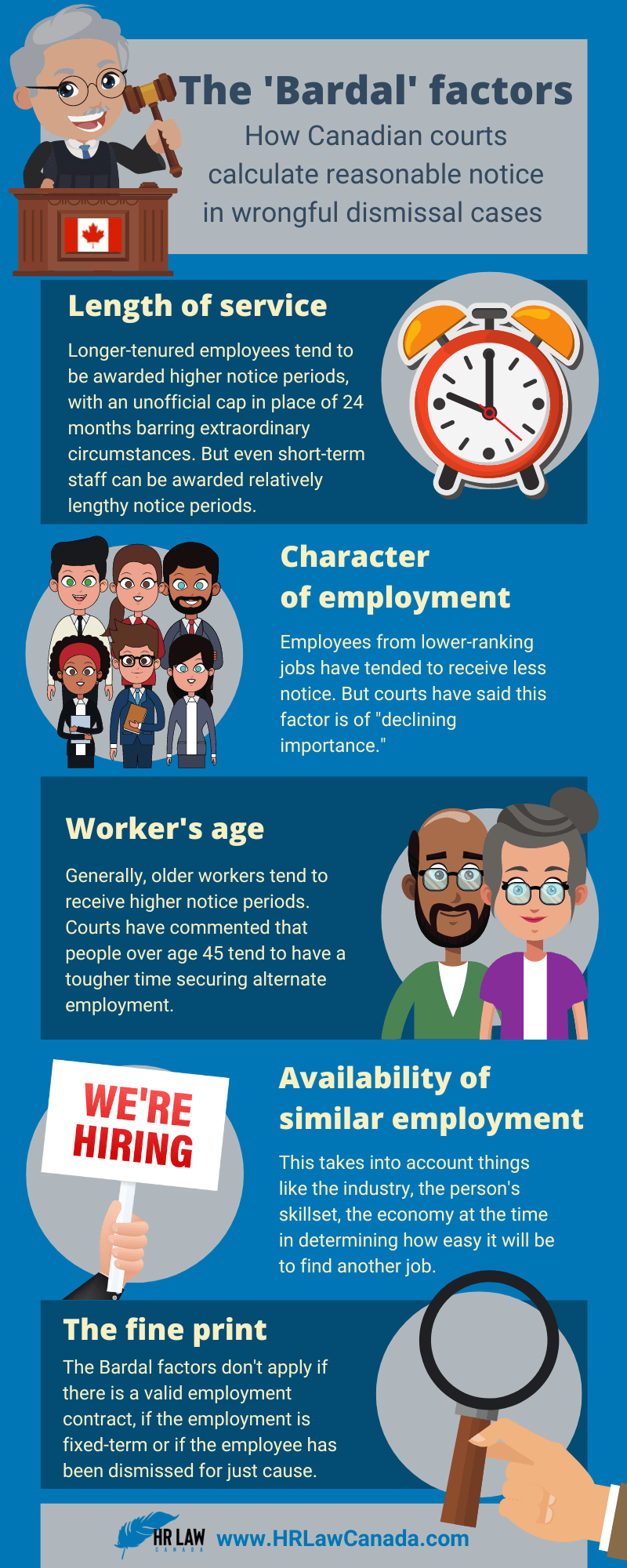
Whenever an employment lawyer or a judge evaluates how many months of common law notice you should receive, they turn to the landmark Ontario High Court decision in Bardal v. Globe & Mail Ltd. (1960).
Justice McRuer established the four primary factors that Canadian courts must balance to decide what constitutes reasonable notice for any individual worker.
+-------------------------------------------------------------------------------+
|                             THE FOUR BARDAL FACTORS                           |
|                                                                               |
|   [ Age of the Employee ]               [ Length of Service ]                 |
|   Older workers face systemic           Longer tenure generally yields        |
|   hiring bias and longer searches       higher cumulative notice periods      |
|                                                                               |
|   [ Character of Employment ]           [ Availability of Similar Work ]      |
|   Specialization, leadership rank,      Current labour market conditions,     |
|   and scope of responsibility           regional supply, and skill demand     |
+-------------------------------------------------------------------------------+
The core principle laid out in the Bardal ruling remains the touchstone of Canadian dismissal law:
Let us break down each of these four factors and how they directly influence your financial bottom line.
Factor 1: Age of the Employee
In the Canadian labour market, older workers face undeniable friction when seeking re-employment. Hiring managers often carry conscious or unconscious biases, and higher salary histories can intimidate prospective employers.
Canadian courts recognize this dynamic. While a twenty-eight-year-old professional with three years of service might receive three or four months of common law notice, a fifty-eight-year-old professional with that exact same three years of service in an identical role could easily receive six to eight months. Judges increase the notice period because common law notice is designed to provide income security for the realistic length of the transition.
Factor 2: Length of Service
Tenure has always been a primary anchor in severance discussions. As a general starting point, longer service yields longer notice periods. An employee with eighteen years of loyal service at a single organization has committed a major portion of their working life to one employer, often making their skills company-specific and their professional network less diversified.
However, a persistent myth in Canadian workplaces is the “rule of thumb” that severance equals exactly one month per year of service. Courts have explicitly and repeatedly rejected this formula.
Short-service employees often receive disproportionately higher ratios. A senior individual terminated after only eight or nine months of work might receive three to four months of common law notice. The reason is simple: starting a new job consumes your career equity, and getting terminated early leaves you with a short, awkward stint on your resume that takes time to explain during interviews.
Factor 3: Character of Employment
Character of employment refers to your job title, rank, supervisory duties, level of specialization, and compensation structure. Historically, courts awarded longer notice periods to executives, directors, and senior managers under the rationale that executive roles are scarce and recruitment cycles for leadership positions take six to twelve months.
While leadership status still commands strong notice periods, modern Canadian jurisprudence has extended similar protections to highly specialized individual contributors. A senior project manager or a principal software architect who does not manage direct reports, but whose technical focus requires rare domain knowledge, will face a long, complex hiring process. The specialized nature of the work lengthens the notice period awarded by the court.
Factor 4: Availability of Similar Employment
Courts evaluate the macroeconomic reality of your sector and your geography at the moment of dismissal. If you are dismissed during a severe industry downturn, mass tech layoffs, or regional hiring freezes, the availability of similar employment plummets.
Judges do not assess your severance in a vacuum. They look at current labour conditions, relying on public economic reality and data from Statistics Canada and the Government of Canada’s Job Bank to assess whether job openings in your field are abundant or severely constrained. When openings are scarce, notice periods stretch upward to account for the slower hiring environment.
Secondary Factors: Inducement and Conduct
Beyond the four primary Bardal factors, courts consider whether you were “induced” or recruited away from a secure, long-term position. If an employer pursued you for six months, convinced you to leave a stable ten-year career, and then terminated you without cause nine months later, courts will often add several months of notice to compensate for the security you sacrificed.
Similarly, if an employer acts in bad faith during the dismissal, such as making false allegations of misconduct, behaving with cruelty, or withholding statutory pay to force you into a quick release, courts can award additional “moral damages” on top of standard common law notice.
The Enforceability Trap: Why Your Contract Clause Might Be Void
Many workers who read their initial employment contract remember seeing a clause that says: “In the event of termination without cause, the company will provide notice or pay in lieu in accordance with the minimum requirements of the applicable provincial Employment Standards Act.”
Seeing this language leads countless individuals to surrender without asking questions. They assume that because they signed the offer letter when they were hired, they waived their common law rights.
That assumption is frequently wrong.
In Canadian employment law, drafting an enforceable termination clause is exceptionally difficult. Canadian courts view employees as the more vulnerable party in contract negotiations and interpret any ambiguity strictly against the employer.
+-------------------------------------------------------------------------------+
|                       TERMINATION CLAUSE VALIDITY CHECK                       |
|                                                                               |
|  Does the clause potentially breach employment standards in ANY scenario?     |
|                                                                               |
|            [ YES ]                                         [ NO ]             |
|               |                                              |                |
|               v                                              v                |
|     Entire clause is VOID                      Clause may successfully limit  |
|   Common law notice is restored                 severance to statutory terms  |
+-------------------------------------------------------------------------------+
The Supreme Court of Canada established in Machtinger v. HOJ Industries Ltd. that employment standards legislation establishes a mandatory legal floor. If a termination clause attempts to provide less than statutory minimums, or if it could potentially violate statutory standards at any point in the future (even under hypothetical conditions), the entire clause becomes void from the start.
When a termination clause is ruled invalid by a court, the contract does not default to statutory minimums. Instead, the entire restriction is struck from the agreement, and the employee’s full entitlement to common law reasonable notice is completely restored.
In major decisions like Waksdale v. Swegon North America Inc., appellate courts confirmed that if any part of a contract’s termination provisions violates the law, such as an overly broad “just cause” provision that denies statutory notice for minor infractions, every termination clause in the contract fails.
In our experience reviewing employment situations, a significant percentage of written termination clauses in Canadian offer letters are legally unenforceable. If you signed a contract years ago, never assume your common law rights are dead until a professional assesses the exact wording.
Step-by-Step: Auditing a Severance Offer Before Signing
Receiving a termination letter triggers an immediate emotional shock. Employers know this, which is why separation paperwork is often packaged with short, artificial deadlines to pressure you into signing a release while you are still off-balance.
Here is the exact, step-by-step process for auditing what you have been offered against what you are actually owed.
Step 1: Do Not Sign Under Pressure
First, understand that an employer’s deadline (e.g., “sign within 72 hours or this offer is rescinded”) is almost always an administrative tactic.
Your employer cannot withhold your statutory minimum termination pay. By law, they must pay you your statutory notice wages and accrued vacation pay within the statutory deadlines dictated by your province (usually within seven to thirty-one days of your final day), regardless of whether you sign a release.
A release form is a legal contract where you give up your right to sue the company for wrongful dismissal in exchange for compensation beyond the statutory minimum. Ask in writing for a reasonable extension to review the documents thoroughly.
Step 2: Separate the Statutory Floor from the Enhancement
Examine the financial breakdown in your separation letter. Look closely at what portion represents mandatory statutory termination pay, what portion represents statutory severance pay (if in Ontario or a federal sector), and what portion represents “gratuitous” or enhanced pay.
If an employer with thousands of global staff hands an eight-year manager an offer of eight weeks of base pay, they have offered nothing more than the bare statutory minimum. They are asking you to sign away your common law rights in exchange for zero additional consideration.
Step 3: Audit Total Compensation and Benefits
Compare the severance offer against your total earning history over the past two to three years. Ask yourself these practical audit questions:
- Did the employer continue health, dental, and disability benefits throughout the full proposed notice window, or are they cutting benefits after the statutory minimum period?
- Are they paying out your pro-rated annual bonus based on your average performance over the past two years?
- What happens to your unvested stock options or RSUs that were scheduled to vest during the notice period?
- Are they paying out all accumulated, unpaid vacation days as a separate line item, or are they attempting to roll vacation pay into the severance total?
If benefits are cut short or variable compensation is excluded, the offer is incomplete.
Step 4: Map Your Situation to the Bardal Metrics
Look honestly at your personal profile: your age, your total years of service, your exact job title and specialized responsibilities, and the current employment climate in your industry.
If you are a forty-eight-year-old team lead with six years of service in a specialized sector where hiring cycles average four to six months, an offer of six to eight weeks of severance does not align with common law principles. A fair common law notice estimate for that profile might sit between five and eight months of total compensation.
Evaluating your career positioning and knowing how your background translates to the active market is an essential part of determining your realistic runway. Having an objective resume assessment helps you understand how quickly you can pivot into comparable vacancies.
Step 5: Structure Your Negotiation Strategy
Once you identify the gap between the initial offer and your common law potential, you have three primary paths forward:
- Direct Negotiation: If the gap is modest (e.g., an extra month of pay, extended benefit coverage, or full bonus inclusion), you can respond professionally in writing. Point out your tenure, your contributions, your total compensation elements, and request an adjusted package without immediately involving external legal counsel.
- Legal Consultation: If the financial gap represents several months of compensation (tens of thousands of dollars), paying for a one-to-two hour consultation with an experienced Canadian employment lawyer is the smartest investment you can make. They can review the enforceable terms of your contract and draft a formal demand letter.
- Formal Litigation: If the employer refuses to budge from a predatory statutory offer, your lawyer can file a statement of claim for wrongful dismissal. The vast majority of wrongful dismissal claims settle through negotiation or mediation long before ever reaching a courtroom.
If you are entering an active job search following a termination, understanding how to negotiate a job offer in Canada will keep you from repeating contract mistakes in your next role.
Furthermore, making sure you understand the nuances of a reference check vs background check in Canada ensures that your negotiated departure agreement includes a clear, agreed-upon letter of reference.
Protecting Your Future in the Canadian Job Market
Navigating a job loss is exhausting, and it is natural to want the situation resolved as fast as possible so you can focus your energy on the future. Employers count on that exhaustion when they construct their initial offers.
Remember that employment relationships in Canada are governed by legal balances established to protect workers when business decisions upend their livelihoods. The initial separation letter you receive is rarely the final word. It is an opening proposal.
Take the time to evaluate your contractual rights, calculate the full value of your compensation, and insist on a severance package that genuinely reflects your common law entitlement.
By understanding the clear boundary between statutory severance pay and common law reasonable notice, you protect your financial health, give yourself a legitimate runway to land your next role, and ensure that years of hard work are respected with a fair and legal departure package.
Key Canadian Employment Resources
- Government of Canada Job Bank: Labour Market Trends
- Government of Canada Jobs & Workplace Standards
- Employment Ontario Workplace Rights & Services
- Alberta ALIS Career Profiles & Occupational Standards
- Statistics Canada: Labour Force Survey Datasets
Related Reading:
- Learn your baseline rights early by understanding probationary period rights in Canada.
- Getting ready to re-enter the market? Read our guide on how to prepare for the fall hiring surge in Canada.
Upcoming career fairs
Career fairs in Ontario
Listings are gathered each month from public event pages. Confirm the details with the organizer before you go.
More From the Blog
BioWare Closure: What It Means for Game Development Careers in Canada
EA's BioWare closure reshapes game development careers in Canada. Here is what studio cuts mean for tech talent in Alberta, Vancouver,...
Read the articleTop 6 Strategies for Finding a Job in Victoria BC
Master finding a job in Victoria BC with our ranked guide to the BC Public Service, Island Health, marine defence, VIATEC tech, and...
Read the articleLittler Survey: What Canadian Employer Hiring Freezes Mean for Workers
Understand how Canadian employer hiring freezes alter hiring timelines in 2026 and master the practical tactics to de-risk your candidacy.
Read the articleReady to Launch Your Career Marketing Campaign?
Book a strategy call and see how Nainly can transform your job search.
Schedule a CallFree consultation. No commitment.