On this page
- What You Need Before You Start Your Job Search
- Step 1: Map the Provincial Designation Pathways (CPHR vs HRPA)
- Step 2: Master Provincial Employment Standards and Canadian Workplace Compliance
- Step 3: Target the Right Gateway Positions
- Step 4: Reframe Your Transferable Skills for Canadian Hiring Managers
- Translating Administrative and Office Work
- Translating Customer Service and Client Support
- Translating Hiring and Training Responsibilities
- Step 5: Build a Strategic Networking and Professional Visibility Plan
- Step 6: Prepare for Scenario-Based Behavioral Interviews
- “Tell me about a time you had to handle confidential information under pressure.”
- “Describe a situation where an employee came to you in severe distress or conflict.”
- “How do you handle a situation where a manager wants to violate company policy or employment law?”
- How to Tell Your Strategy Is Working
Breaking into human resources in Canada can feel like trying to solve a puzzle where someone swapped the box art halfway through. If you are an internationally trained professional, you have probably run into the classic catch-22: Canadian employers want “Canadian experience,” but nobody wants to give you the first gig so you can get it. If you are a career changer coming from administration, customer service, or operations, you might keep hearing that you lack formal HR credentials, even though you have been dealing with workplace policies and scheduling conflicts for five straight years.
The biggest misconception about landing a human resources job in Canada is that passion for people is enough. It is not. You will never hear a seasoned hiring manager say, “We picked this candidate because they just love chatting with coworkers.”
Human resources in Canada is fundamentally a risk management, compliance, and operational function. Canadian employers hire HR professionals to protect them from wrongful dismissal claims, maintain compliance with provincial employment standards, track payroll inputs without error, manage privacy obligations, and build hiring funnels that do not violate human rights legislation. Once you shift your perspective from being a friendly people champion to being a reliable guardian of workplace processes, your entire search changes.
The Canadian market offers substantial financial rewards once you get your foot through the door. According to wage data updated in November 2025 by the Government of Canada Job Bank, the national median wage for human resources professionals (NOC 11200) sits at $40.87 per hour, which works out to roughly $85,000 annually for full-time schedules. In higher-cost regions like British Columbia, senior managers earn even more, with WorkBC reporting a median hourly rate of $57.69 for HR managers.
Reaching those salaries requires passing through entry gates that are heavily guarded by credentialing bodies and applicant tracking systems. This tutorial breaks down the exact sequence you need to follow to build credibility, master provincial regulations, tailor your background, and secure your first human resources job in Canada.
What You Need Before You Start Your Job Search
Before you draft a single cover letter or send an application into an online portal, you must establish an honest baseline of where you stand. Applying to HR roles without meeting baseline structural expectations is an exercise in burning out your motivation. Here is what needs to be in place first.
First, clarify your legal right to work. Canadian employers routinely verify work eligibility during early screening calls. If you are on an open work permit, a post-graduation work permit, or hold permanent residency or citizenship, make that clear in your job applications. If you require employer sponsorship, breaking into an entry-level HR role is extraordinarily difficult because entry-level administrative positions rarely qualify for Labour Market Impact Assessments (LMIAs).
Second, gather your academic documentation. Most Canadian employers expect an undergraduate degree or a two-year college diploma in business, human resources, psychology, or a related social science. If your education was completed outside Canada, you should initiate an educational credential assessment through recognized evaluation services like World Education Services (WES) or the International Credential Assessment Service (ICAS). You will need these certified evaluation reports not just for prospective employers, but also to register with provincial HR associations.
Third, get comfortable with the core tech stack used across Canadian offices. Entry-level HR practitioners are transactional powerhouses. You will spend hours managing applicant tracking systems (ATS) like Greenhouse, Lever, Workday, or BambooHR, alongside human resources information systems (HRIS) such as ADP Workforce Now, Dayforce, or UKG. You do not need expensive certifications in all of them, but you do need to know the basic mechanics of how employee records are stored, how time-off requests are tracked, and how candidate pipelines move through hiring stages.
Finally, prepare yourself psychologically for starting below your previous ceiling if you have international seniority. If you managed an HR department of forty people in your home country, you might feel qualified to walk straight into an HR Director role in Calgary or Toronto. The market will almost certainly disagree. Canadian employment law, human rights codes, and workplace culture are intensely localized. Accept that you may need to spend twelve to twenty-four months in a coordinator, specialist, or generalist role to prove your operational fluency under Canadian statutes before reclaiming your executive title.
Step 1: Map the Provincial Designation Pathways (CPHR vs HRPA)
Professional certification carries immense weight in Canadian HR, but the regulatory structure trips up thousands of applicants every year because Canada does not have a single unified body.
Instead, the country is split into two distinct jurisdictions. In nine provinces and all three territories, the gold standard is the Chartered Professional in Human Resources (CPHR), governed nationally by CPHR Canada and administered by provincial member associations like CPHR Alberta, CPHR BC & Yukon, or CPHR Nova Scotia.
Ontario is the sole outlier. In 2014, Ontario broke away from the national council, and its HR profession is regulated separately by the Human Resources Professionals Association (HRPA). In Ontario, credentials follow a three-tiered model: the Certified Human Resources Professional (CHRP) for entry-to-mid practitioners, the Certified Human Resources Leader (CHRL) for senior and management practitioners, and the Certified Human Resources Executive (CHRE).
You must know which jurisdiction you are operating in. An employer in Edmonton or Vancouver will look for CPHR candidacy, while an employer in Mississauga or Ottawa will scan your resume for HRPA affiliation or CHRP progress.
The good news is that you do not need to hold the full designation on day one of your job hunt. In fact, you cannot hold it yet if you do not have verified professional work experience in Canada or abroad. What you can do, and should do immediately, is join your respective provincial association as a general, associate, or student member.
Here is a practical look at how CPHR requirements are structured nationally:
This standard is one of the most overlooked details by newcomers. Many skilled immigrants mistakenly assume that because Canadian recruiters want “local experience,” CPHR Canada also dismisses overseas work. That is simply false. For your Validation of Experience (VOE) assessment, foreign experience is fully accepted, provided your responsibilities mapped to the functional knowledge areas defined in the CPHR Competency Framework.
To help visualize how the national qualification paths work from initial membership through examination and experience validation, review this progression chart:
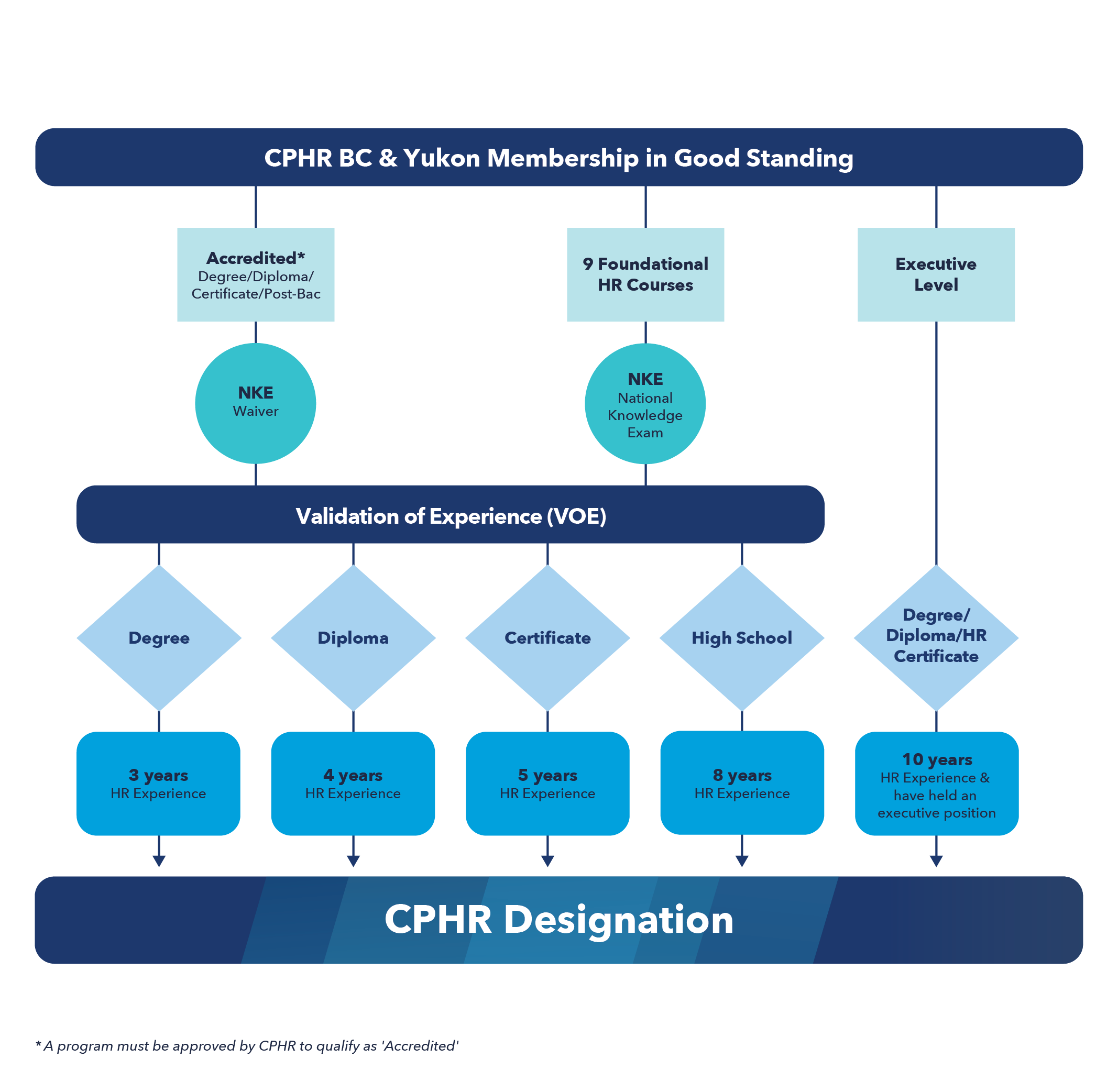
If you have a recognized degree or diploma, you can register to sit for the National Knowledge Exam (NKE) in the CPHR provinces, or the CHRP Knowledge Exam (CHRP-KE) in Ontario. If you graduated from an accredited Canadian post-secondary program with a cumulative GPA above the required threshold (typically 70% or 2.7 depending on the school and province), you might qualify for an NKE waiver entirely.
Passing the knowledge exam grants you the “CPHR Candidate” status in the nine CPHR provinces, or candidate status with HRPA in Ontario. Putting “CPHR Candidate” or “CHRP Candidate” at the top of your resume tells hiring teams three things: you know the regulatory theory, you have made a financial commitment to the profession, and you are bound by a legal code of professional conduct.
In this video, Canadian HR consultant Shauna Cole breaks down the practical considerations behind pursuing the CPHR credential and how it impacts compensation and career velocity:
Signing up for an association membership costs money, usually between $200 and $500 annually, depending on your student or professional category. If your budget is tight, this can sting. Still, consider it an operational cost of doing business. The association job board, directory, and regional events give you access to a hiring community that casual applicants browsing public job boards will never reach.
Step 2: Master Provincial Employment Standards and Canadian Workplace Compliance
Nothing terrifies a Canadian hiring manager more than an HR applicant who does not know basic labour legislation. If an operations manager hires a flawed administrative assistant, documents get misfiled. If an operations manager hires an HR coordinator who miscalculates statutory holiday pay or mishandles an accommodation request, the company ends up facing a Ministry of Labour investigation or a costly human rights tribunal hearing.
You do not need a law degree, but you must become intimately familiar with the employment statutes of the province where you intend to work.
In Canada, roughly 90 percent of the workforce falls under provincial labour laws, while the remaining 10 percent (banking, telecommunications, interprovincial transport, federal crown corporations) falls under the federal Canada Labour Code. Unless you are targeting a federally regulated bank or airline, your daily bible will be your provincial legislation: the Employment Standards Act (ESA) in Ontario or British Columbia, the Employment Standards Code in Alberta, or the Act Respecting Labour Standards in Quebec.
You should sit down and read the actual government fact sheets on these statutes. Pay rigorous attention to five areas:
First, understand overtime rules and daily maximums. Many newcomers are shocked to discover that in provinces like Alberta or British Columbia, daily overtime kicks in after eight hours in a single day, regardless of whether the employee worked forty hours that week. Learn what “statutory holiday pay average daily wage” calculations require, and understand the difference between exempt managerial staff and non-exempt operational staff.
Second, master the legal mechanics of ending employment. You need to know the statutory notice periods and severance pay requirements outlined in your provincial act, but you also must understand that common law notice usually far exceeds statutory minimums. Learn what “just cause” actually means in Canada: an exceptionally high legal bar that requires extensive progressive discipline and documentation, rather than a manager simply waking up in a bad mood and deciding to fire someone. In fact, refreshing your understanding of probationary period rights in Canada will help you speak intelligently about onboarding risk during interviews.
Third, learn the Canadian Human Rights framework and the “duty to accommodate.” In Canada, employers have an affirmative legal duty to accommodate employees based on protected grounds (such as disability, family status, religion, or race) up to the point of “undue hardship.” If a candidate asks for flexible hours to care for an elderly parent or an employee needs modified duties after a non-work injury, HR cannot simply quote an attendance policy and issue a warning. You must know how the collaborative accommodation process functions.
Fourth, understand privacy legislation. Canada enforces the Personal Information Protection and Electronic Documents Act (PIPEDA) at the federal level, with substantially similar private-sector privacy acts operating in Alberta (PIPA), British Columbia (PIPA), and Quebec (Law 25). In an HR role, you will handle social insurance numbers, banking data, medical notes, and background checks. Knowing how this data must be stored, who is allowed to see it, and when it must be purged is mandatory knowledge.
Here is how the regulatory body in Ontario frames the broader purpose of holding practitioners to strict frameworks:
The primary purpose of certification is to promote and protect the public interest by identifying those professionals who have met specific standards of qualifications, knowledge, skill, competence, ethics, etc.
Source: Human Resources Professionals Association, Guide to the CHRP Designation
Many applicants treat HR certification as a cosmetic badge on a LinkedIn profile. As HRPA points out, the real function of a professional standard is public and organizational protection. When you speak about compliance in an interview, frame your knowledge not as an academic memory exercise, but as a commitment to keeping the organization fair, legally compliant, and protected from unnecessary liability.
Step 3: Target the Right Gateway Positions
When searching for a human resources job in Canada, your title targeting can make or break your timeline. If you search broadly for “Human Resources,” you will drown in listings requiring seven years of specialized experience in total rewards or collective bargaining.
To break in, you need to aim your crosshairs squarely at gateway positions. These roles are designed to absorb operational volume and serve as the proving ground for the department.
The primary entry title in Canada is Human Resources Assistant or Human Resources Coordinator. In these roles, you are responsible for maintaining employee files in the HRIS, coordinating interview logistics, sending offer letters, kicking off background checks, preparing onboarding packages, and answering front-line inquiries about benefits or vacation balances.
Another viable entry route is Recruitment Coordinator or Talent Acquisition Coordinator. Rather than handling general employee relations, you focus entirely on the hiring funnel. You will post job descriptions across platforms, screen resumes, schedule multi-stage panel interviews, manage hiring manager calendars, and draft employment agreements.
A third pathway is People Operations Specialist or HR Administrator. In smaller startups or medium-sized businesses, this title often combines traditional HR coordination with light office management or basic payroll data entry. If your background includes working as an office administrator or an administrative assistant, this role is your natural bridge.
Consider this perspective on entry-level credentials from industry analysis:
That observation matches what we see in the hiring trenches. When a company posts an HR Coordinator role in Toronto, Vancouver, or Calgary, they frequently receive three to five hundred applications within seventy-two hours. Recruiter eyes do not read every sentence on every resume. They look for specific filters, and an entry-level credential like CHRP or CPHR Candidate status immediately validates that you understand recruitment and workplace policies.
If you are planning your path in Ontario specifically, this practical breakdown by HR with HP covers the coursework, exam prerequisites, and Job Ready Program required by HRPA:
Notice that none of these entry roles require you to design executive incentive plans or negotiate collective agreements with unions. They require organizational speed, meticulous documentation, zero data-entry errors, and strong professional discretion. If you position yourself as someone who will take the administrative burden off the HR Director’s shoulders without making careless mistakes, you will get hired.
Step 4: Reframe Your Transferable Skills for Canadian Hiring Managers
If you do not have direct Canadian HR experience on your resume, how do you convince a hiring manager that you can handle the work? You do it by systematically dismantling your past roles and rebuilding them around core HR competencies.
The biggest mistake career switchers make is leaving their past titles described in the language of their former industry. If you were a store manager, an executive assistant, an operations lead, or a teacher, you have probably spent dozens of hours doing tasks that map directly to HR functional areas. The problem is that your resume currently describes those tasks from an operational standpoint rather than a people-process standpoint.
Let us look at how to translate common experiences into language that resonates with Canadian HR teams.
Translating Administrative and Office Work
If you handled general administrative duties, you almost certainly managed sensitive documents, coordinated onboarding for new staff members, updated spreadsheets with employee personal information, and scheduled cross-departmental meetings.
Do not write: “Answered emails, scheduled meetings, and filed employee forms.” Reframe it as: “Maintained confidential digital personnel files for a team of 45, ensuring full adherence to privacy standards; coordinated end-to-end onboarding schedules and IT provisioning for 12 new hires annually.”
Translating Customer Service and Client Support
If you spent years in retail management, hospitality, or client escalations, you have handled intense interpersonal conflict, de-escalation, and policy enforcement under pressure.
Do not write: “Dealt with unhappy customers and resolved complaints.” Reframe it as: “Applied organizational policies to de-escalate complex disputes, maintaining compliance with internal codes of conduct and documenting incident reports with 100% accuracy.”
Translating Hiring and Training Responsibilities
Many team leads, supervisors, and shift managers participate in hiring and staff development without realizing that it constitutes formal HR functional experience.
Do not write: “Trained new cashiers and helped manager interview people.” Reframe it as: “Screened candidate resumes against operational role requirements, conducted structured initial interviews, and facilitated a 2-week job-readiness curriculum that decreased new hire ramp-up time by 15%.”
When assembling your resume, stick to a structured layout that prioritizes recent work history and quantifiable outcomes. Using a proven chronological vs functional resume format is essential here. Recruiters in Canada are deeply suspicious of functional formats that hide employment dates or obscure where specific duties took place. If you are uncertain about whether your bullets read like administrative support or true HR operations, getting a professional resume assessment can help you spot terminology gaps before you blast applications out into the void.
Make sure your resume highlights specific tools. If you know how to run a VLOOKUP in Excel to reconcile a benefits report, say so. If you have generated pivot tables to analyze employee turnover by department, make it a bullet. Canadian HR departments are increasingly expected to back up their recommendations with data. Proving that you are technologically literate and comfortable handling numbers makes you twice as attractive as someone whose pitch rests solely on interpersonal charm.
Step 5: Build a Strategic Networking and Professional Visibility Plan
Sending cold applications through job boards is like throwing paper airplanes into a stiff headwind. You might get lucky if the wind catches one just right, but most of them will dive straight into the pavement.
In Canada, an estimated 60 to 70 percent of open positions are filled through what career advisors call the “hidden job market.” In human resources, this dynamic is amplified. Because HR professionals are the very people who write the job descriptions and review the incoming resumes, they know better than anyone how saturated job boards are. When an HR Director needs an assistant or coordinator, their first instinct is not to sift through four hundred cold resumes. Their first instinct is to ask their team or their professional network: “Does anyone know a sharp, dependable coordinator looking for a break?”
If you are not visible in those circles, you do not exist to them.
Building visibility does not mean sending generic messages on LinkedIn asking strangers for a job or a referral. That approach generates irritation, not interviews. Instead, execute a disciplined, multi-channel networking plan focused on learning and building relationships.
Start with your local association chapters. If you are an HRPA member in Ontario, join your regional chapter (such as the Toronto, Peel, or Ottawa chapters) and attend their monthly professional development breakfast or webinar sessions. If you are a CPHR member in Alberta, attend the local mixer in Calgary or Edmonton. Volunteer to help staff the registration desk at their annual conferences. Handing out name badges is the single easiest way to introduce yourself to three hundred HR leaders in a single morning without feeling awkward.
Next, identify target companies in your geographic area. Make a list of thirty mid-sized organizations with thirty to two hundred employees. Why mid-sized? Because large multinational corporations have rigid hiring processes that run strictly through automated portals, while tiny mom-and-pop businesses do not have dedicated HR departments. Mid-sized companies are in the sweet spot: they have growing people operations, their HR teams are small and overworked, and the HR Manager or Director is directly accessible.
Reach out to HR Generalists and HR Specialists at these companies for twenty-minute informational conversations. Notice that we did not say reach out to the VP or Chief People Officer. Senior executives are insulated and rarely have time to chat with an aspiring coordinator. Mid-level practitioners, however, remember exactly what it felt like to look for their first human resources job in Canada three years ago.
When you send a connection request, make it specific and flattering:
“Hi Sarah, I saw your recent post about updating your remote onboarding workflows at [Company]. As someone working toward my CPHR Candidate status and transitioning into people operations in Calgary, I really admire your team’s approach to culture. If you ever have fifteen minutes for a virtual coffee, I would love to ask about what competencies you find most critical for coordinators in your sector. No job expectations whatsoever, just eager to learn from someone doing great work locally.”
Notice what this message does: it asks for advice, not a job. It demonstrates that you researched their work, signals your CPHR pursuit, and removes the pressure of an interview. When you get on that call, show up with three intelligent questions about their systems, their compliance challenges, and their industry trends. Send a thoughtful thank-you note within twenty-four hours. More often than you would imagine, when that team opens a coordinator requisition three weeks later, you will be the first person they invite to apply.
Step 6: Prepare for Scenario-Based Behavioral Interviews
Once your networking and tailored applications generate traction, you will face the Canadian HR interview panel. HR interviews are uniquely difficult because the people interviewing you are professional interviewers themselves. They know every textbook trick, every canned answer, and every evasive maneuver.
If you regurgitate standard, scripted responses like “my biggest weakness is that I work too hard,” you will be eliminated immediately. Canadian HR panels evaluate two things above all else: sound judgment and ironclad discretion.
Most interviews for an entry-level human resources job in Canada will revolve around behavioral questions structured around the STAR method vs CAR method. You must come prepared with four to five robust, detailed stories that demonstrate how you handle pressure, confidentiality, and procedural fairness.
Prepare specific scenarios for these core interview questions:
“Tell me about a time you had to handle confidential information under pressure.”
HR practitioners handle the company’s deepest secrets: termination lists, compensation figures, sexual harassment complaints, and medical leaves. The panel wants to know whether you can keep your mouth shut when an inquisitive manager or friendly coworker tries to fish for details. Walk through a specific situation where you were pressured to disclose something, how you set a polite but firm professional boundary, and how you ensured digital or physical documents stayed protected.
“Describe a situation where an employee came to you in severe distress or conflict.”
The panel wants to assess your emotional regulation. A junior HR employee must show empathy without making promises the company cannot legally or financially keep. If an employee comes to you crying because their manager screamed at them, a poor HR coordinator says, “Oh no, that manager is terrible, I will make sure they get disciplined.” A skilled HR coordinator says, “I hear how upset you are. Let us sit down in a private space, walk through what happened step by step, take detailed notes, and I will outline our investigative process so you know what happens next.” Show the panel that you can balance empathy with procedural rigor.
“How do you handle a situation where a manager wants to violate company policy or employment law?”
This is the classic HR acid test. A sales director demands to fire an underperforming account representative on the spot with zero warning and no documentation. How do you respond? Your answer should demonstrate that you do not pick fights or wield policy like a blunt weapon. Instead, explain how you partner with the manager, educate them on the legal and financial liability of a wrongful dismissal claim, review the statutory requirements under the provincial employment standards code, and build a structured performance improvement plan (PIP) that gives the employee a fair chance while building a legally defensible audit trail for the company.
Finally, remember that Canadian hiring teams will run rigorous background checks before finalizing an offer. Being clear on the difference between a reference check vs background check in Canada ensures you have appropriate supervisory references lined up who can speak specifically to your reliability, attendance, ethics, and emotional maturity.
How to Tell Your Strategy Is Working
Executing a targeted career transition takes stamina. It is easy to get discouraged after two weeks and wonder if anyone is actually reading your applications. To avoid spinning your wheels, track your progress against concrete conversion metrics rather than emotional impressions.
Here is what a healthy job search funnel looks like when your strategy is tuned correctly.
If you are submitting twenty targeted, well-customized applications per month and networking actively, you should expect:
- A profile view or initial recruiter outreach rate of roughly 10 to 15 percent of your total touchpoints.
- A conversion from application to initial HR phone screening of approximately 5 to 8 percent.
- A conversion from phone screen to hiring manager panel interview of 50 percent or higher.
If you have sent fifty applications and received absolute silence, your bottleneck is top-of-funnel: your resume format is failing ATS parsing, your transferable skills are still framed in your old industry’s jargon, or you are applying for roles that require credentials you do not yet list.
If you are consistently passing the fifteen-minute recruiter phone screen but failing to secure the panel interview, the issue is your positioning: you may be speaking too broadly about “loving people” rather than highlighting technical compliance, HRIS tools, and organizational execution.
If you reach the final interview round twice but lose out to other candidates, take heart: your strategy is fundamentally working. At that stage, you are losing out by inches, often to someone who simply had six more months of direct Canadian experience in that specific vertical. Stay persistent, ask for constructive feedback, keep attending your local association events, and continue building your operational knowledge.
Securing a human resources job in Canada takes methodical preparation, an understanding of regional regulations, and the humility to start where the organization needs you most. When you treat your job search with the same analytical rigor, compliance discipline, and structured communication that you will bring to the office every day, Canadian employers will recognize you not just as an applicant looking for work, but as a trusted professional ready to safeguard their workplace.
More From the Blog
Team Canada Strong: How to Access Skilled Trades Training in Canada
Learn how to access funded skilled trades training in Canada under Team Canada Strong, find sponsor employers, and land a registered...
Read the articleTop 6 Strategies for Finding a Job in Halifax
Looking for work in Nova Scotia? Here is our ranked guide to finding a job in Halifax, from ocean tech hubs to regional referral networks...
Read the articleIRCC Express Entry CEC Draws: What Canadian Workers Need to Know
Learn how recent Express Entry CEC draws impact temporary workers in Canada, plus clear steps to optimize your CRS score and secure...
Read the articleReady to Launch Your Career Marketing Campaign?
Book a strategy call and see how Nainly can transform your job search.
Schedule a CallFree consultation. No commitment.