On this page
- What You Need Before You Start
- Step 1: Diagnose and Categorize the Core Reason for Your Time Away
- Scenario A: Corporate Restructuring, Layoffs, and Economic Downsizing
- Scenario B: Family Caregiving, Parental Leave, and Eldercare
- Scenario C: Immigration Relocation and Settlement in Canada
- Scenario D: Deliberate Retraining, Upskilling, and Career Pivoting
- Step 2: Build Your Three-Part Response Script
- Pillar 1: Acknowledge with Brevity
- Pillar 2: Highlight Productive Action
- Pillar 3: Execute the Bridge and Pivot
- Step 3: Select and Customize Your Scenario-Specific Script
- Script 1: Layoff or Corporate Downsizing
- Script 2: Family Caregiving or Extended Parental Leave
- Script 3: Relocation and Settlement in Canada
- Script 4: Intentional Career Pivot and Retraining
- Script 5: Medical Recovery or Personal Health Hiatus
- Step 4: Rehearse Delivery and Deflect Common Interrogation Traps
- 1. Eliminate the Apology Reflex
- 2. Guard Against the Oversharing Spiral
- 3. Maintain Absolute Timeline Integrity
- 4. Practice Under Simulated Stress
- Common Pitfalls and What NOT to Say
- How to Tell Your Strategy Worked
- Frequently Asked Questions
- How long of an employment gap requires an explanation?
- Should I explain my employment gap directly on my resume?
- What if my employment gap is happening right now and has lasted over a year?
- Can a Canadian employer ask for proof of medical or personal reasons for a gap?
Sitting across from a hiring manager or staring into a webcam during a video screening, you feel the familiar dread creeping up. The interviewer flips through your resume, pauses, and looks directly at you: “I notice there is a nine-month gap here between 2024 and 2025. Can you walk me through what happened there?”
Your heart rate spikes. Your instinct might be to scramble, over-explain, apologize, or launch into a defensive monologue about difficult market conditions.
Do not do that.
Having a break in your work history is not a career death sentence. In fact, prolonged job searches and career pauses happen constantly across Canada. According to Statistics Canada, the average duration of unemployment across the country reached 21.8 weeks in 2025, with tens of thousands of professionals taking six months or longer to secure their next positions amid economic restructuring. Add in standard Canadian parental leaves, eldercare responsibilities, international relocation, or deliberate retraining periods, and resume gaps are practically standard.
Hiring managers do not reject candidates simply because they took time away from paid employment. They reject candidates who sound insecure, evasive, bitter, or unprepared when discussing it.
When you learn how to explain an employment gap in an interview with clarity, confidence, and brevity, you transform an awkward interrogation point into proof of your resilience and focus. This tutorial walks you through the exact four-step system to construct, refine, and deliver an airtight explanation that shifts the interviewer’s attention right back to why you are the best person for the job.
What You Need Before You Start
Before you write a single practice script or step into an interview room, take stock of a few fundamentals. Preparing this explanation requires honest self-reflection and specific structural pieces.
Here is what you should pull together first:
- Your master career timeline with exact months and years of employment, contract work, and downtime.
- A candid inventory of every productive activity you undertook during your break, including professional development courses, micro-credentials, volunteer commitments, family care duties, freelancing, or independent projects.
- The specific job description you are targeting, noting core competencies where you need to steer the conversation.
- A voice memo app on your phone or your computer webcam for recorded practice sessions.
If your resume formatting currently screams about your gap before you even get invited to an interview, consider whether a chronological vs functional resume format makes sense for your specific career stage. You can also get an objective read on how your timeline looks to recruiters through a professional resume assessment.
Once you have your timeline and activities mapped out, work through the four steps below sequentially.
Step 1: Diagnose and Categorize the Core Reason for Your Time Away
The biggest mistake candidates make is treating every gap the same way. An explanation for a corporate restructuring sounds completely different from an explanation for caregiving or settling into Canada after immigrating.
Start by isolating your exact scenario into one of four primary categories recognized in the Canadian labour market.
Scenario A: Corporate Restructuring, Layoffs, and Economic Downsizing
Corporate restructurings happen in every sector, from tech layoffs in Vancouver and Toronto to energy consolidations in Calgary. When your departure was driven by organizational budget cuts, departmental elimination, or macroeconomic contraction, you carry zero personal blame.
The key here is externalizing the decision without sounding like a victim. You were part of a business adjustment, not singled out for incompetence.
Scenario B: Family Caregiving, Parental Leave, and Eldercare
Canada has robust legal and cultural frameworks supporting family leave, but private-sector job searches after an extended leave require clear messaging. Interviewers want reassurance on one point above all others: is your family situation stable now, allowing you to focus entirely on full-time work?
You do not need to disclose deeply personal medical or domestic details. You only need to explain that you took intentional time to care for family and that your support systems are now firmly established.
Scenario C: Immigration Relocation and Settlement in Canada
Newcomers often face an unavoidable break while navigating permanent residency processing, international relocation logistics, credential assessments, and initial settlement.
If you are a newcomer establishing yourself in a city like Toronto or Calgary, hiring managers want to know that your legal work authorization is settled and that you understand local workplace norms. Highlighting steps you took to adapt to the market turns a relocation gap into evidence of initiative.
Scenario D: Deliberate Retraining, Upskilling, and Career Pivoting
Perhaps you stepped back from an administrative role to study data analytics, or you left retail management to complete certifications for a project manager track.
When you initiate a career pause to upgrade your skills, the gap is not empty time. It is an intentional investment. Your goal is showing that the skills you gained directly solve problems for the employer sitting in front of you.
Understanding recruiter psychology on this issue helps you frame your timeline without fear. Here is a candid discussion from talent acquisition specialists breaking down how hiring teams evaluate CV pauses:
Step 2: Build Your Three-Part Response Script
Regardless of which scenario fits your background, every great interview answer follows a repeatable structure. We call this the Three-Pillar Framework: Acknowledge, Action, and Pivot.
+-------------------------------------------------------------------+
|                   THE THREE-PILLAR FRAMEWORK                      |
+-------------------------------------------------------------------+
|  1. ACKNOWLEDGE (10-15 seconds)                                   |
|     State the factual reason clearly. No apologies, no guilt.    |
+-------------------------------------------------------------------+
|  2. ACTION (15-20 seconds)                                        |
|     Highlight productive growth, coursework, freelance work,      |
|     or personal resilience built during the hiatus.               |
+-------------------------------------------------------------------+
|  3. PIVOT (10-15 seconds)                                         |
|     Tether your readiness directly back to the target role's      |
|     immediate requirements and ask an engaging question.          |
+-------------------------------------------------------------------+
Your entire answer should clock in between 35 and 50 seconds. If you talk for two minutes about your gap, you signal that you are uncomfortable with it. The interviewer will dig deeper simply because your nervous energy suggests there is something hidden under the surface.
Let us break down each pillar in detail.
Pillar 1: Acknowledge with Brevity
State what happened factually, calmly, and without defensive posturing. Use plain language. Avoid euphemisms that sound like corporate evasion, like “I decided to pursue synergy outside the matrix.”
State the facts: “In early 2025, my previous company downsized its operations team due to a market contraction, and my role was eliminated alongside several others.”
Notice the tone. It is steady, objective, and unapologetic.
Consider how professional career guides advise handling this opening moment. As noted in Monster’s career advice resources:
Keeping the explanation simple prevents the interviewer from getting lost in unnecessary background details that do not help your candidacy.
Pillar 2: Highlight Productive Action
What did you do during the break that kept your mind sharp or built valuable life skills?
You do not need to claim you built a multinational enterprise in your living room. Meaningful actions include completing online certifications, taking specialized courses through local institutions, volunteering with non-profits, freelancing, managing complex home logistics, or methodically researching target industries.
Even if your break was primarily focused on recovery or caregiving, frame the period as intentional: “I used that time to manage our family commitments while completing coursework in cloud architecture to keep my technical proficiencies aligned with current industry tools.”
Pillar 3: Execute the Bridge and Pivot
This is where mediocre candidates fail and great candidates shine. You must bridge your explanation back to the open role. Do not finish your sentence and leave an awkward, dangling silence. Conclude by declaring your energy for the role and asking an interview question that hands control back to the interviewer.
Example bridge: “With those responsibilities completed and my certifications finalized, my sole focus is bringing these updated workflow management skills to your logistics team. That is why I was so excited to see your current focus on supply chain modernization. How is your team currently approaching that rollout?”
By ending on a relevant question, you redirect the meeting back to business value.
Step 3: Select and Customize Your Scenario-Specific Script
Now let us apply the Three-Pillar Framework to specific real-world situations. Review the five customized templates below, choose the one that matches your circumstances, and tailor the bracketed details to your actual background.
Script 1: Layoff or Corporate Downsizing
Use this script when your departure resulted from budget reductions, mergers, business closures, or broader industry cutbacks.
Why this works: It clarifies that the layoff was systemic rather than performance-based, proves you maintained your skills through real application, and immediately moves to solving their business problems.
Script 2: Family Caregiving or Extended Parental Leave
Use this script if you stepped away from work to raise young children, care for an ailing parent, or support a family member through a health crisis.
Why this works: It provides clear closure regarding the family situation without violating your private life, demonstrates continuous learning, and demonstrates strong enthusiasm for returning to work.
Script 3: Relocation and Settlement in Canada
Use this script if you moved to Canada from abroad and experienced a gap while obtaining work authorizations, landing in your new province, and acclimating to the local job market.
Why this works: It addresses the newcomer timeline head-on, confirms legal work readiness, highlights proactive Canadian credential upgrading, and frames international background as an asset.
If you are currently navigating this transition, review our detailed guide on how to get Canadian work experience as a newcomer to supplement your interview messaging.
Script 4: Intentional Career Pivot and Retraining
Use this script if you quit your previous job voluntarily to transition into a new industry, discipline, or functional specialty.
Why this works: It proves intentionality. You did not wander aimlessly; you executed an educational investment to become more valuable to employers.
If you took a voluntary severance package or negotiated exit to make this pivot, you are not alone in using buyouts to change directions. As career expert advice published on The Muse emphasizes:
Framing structural departures or planned exits around group realities keeps the narrative clean, professional, and positive.
Script 5: Medical Recovery or Personal Health Hiatus
Use this script if you stepped away to resolve an illness, undergo surgery, or recover from physical burnout.
Why this works: Canadian human rights legislation prohibits employers from asking for detailed medical histories. This script respects legal boundaries, gives clear confirmation of full recovery, and shifts straight to enthusiasm for the job.
Understanding how former corporate hiring managers dissect these explanations can demystify the entire interview dynamic:
Step 4: Rehearse Delivery and Deflect Common Interrogation Traps
Writing the script is half the battle. Delivering it without trembling or getting tripped up by follow-up inquiries requires disciplined rehearsal.
Work through these four execution rules to ensure your delivery matches your preparation.
1. Eliminate the Apology Reflex
Never start your answer with:
- “I’m sorry, I know my resume looks a little messy…”
- “Unfortunately, I have a big gap here…”
- “I know this looks bad, but…”
When you apologize, you tell the interviewer that you believe you did something wrong. You have nothing to apologize for. Taking time to care for an elderly parent, recover from surgery, retrain, or look for work during an economic downturn is normal human life. Deliver your answer with the same matter-of-fact tone you would use to describe your previous job duties.
2. Guard Against the Oversharing Spiral
When humans feel nervous, they talk too much. In an interview room, nervous chatter kills candidacies.
If you spent eight months caring for a parent, do not describe hospital schedules, medication regimens, or emotional disputes with siblings. If you were laid off because of a toxic manager, do not complain about company politics.
Keep your explanation bounded by the Three-Pillar structure. Once you deliver Pillar 3 and ask your redirect question, stop talking. Let the silence belong to the interviewer.
3. Maintain Absolute Timeline Integrity
Never fudge your employment dates on your resume or application form to cover up a gap.
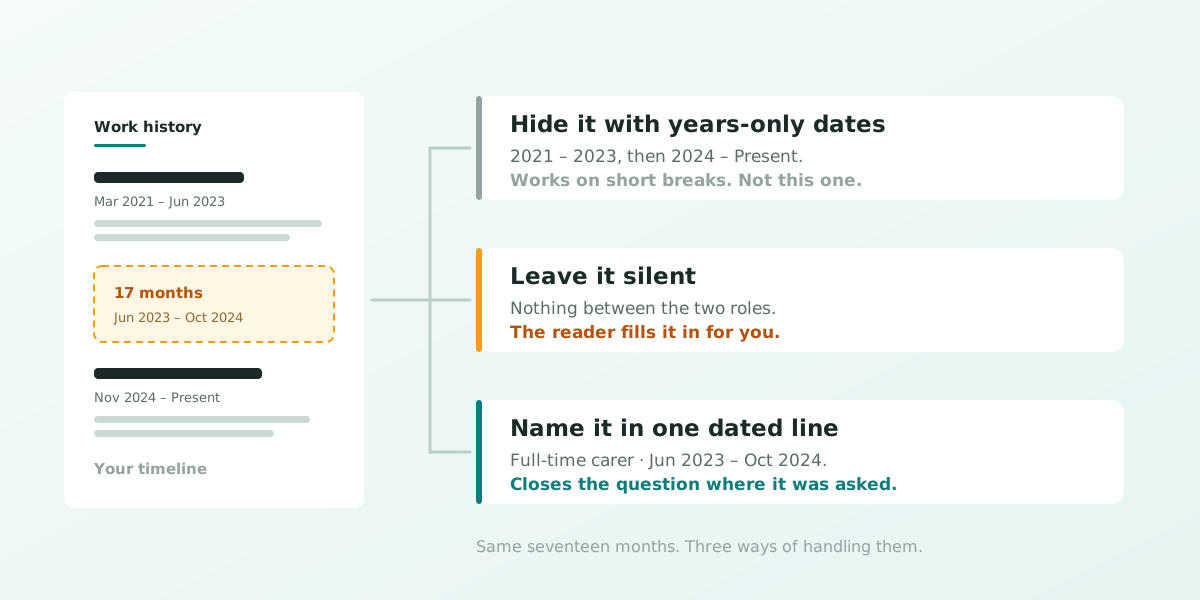
Some candidates change “March 2024” to “November 2024” or list only years (e.g., “2023-2025”) hoping the recruiter will assume continuous employment. While using year-only formats on resumes is a common styling choice, lying about specific dates on formal digital application portals will backfire during the background check phase.
In Canada, third-party screening agencies regularly verify exact start and end dates with former HR departments. To understand what companies actually verify during post-interview vetting, review our comparison of reference check vs background check in Canada. A six-month resume gap will rarely lose you a job offer; a documented lie about your employment dates will lose it every time.
4. Practice Under Simulated Stress
Do not just read your script silently in your head. Silent reading uses different cognitive pathways than spoken conversation.
Record yourself answering the question on your phone camera. Play it back and evaluate your performance against these specific markers:
- Did your answer finish under 50 seconds?
- Did your voice pitch upward at the end of statements, making you sound uncertain?
- Did your eyes wander away from the camera or interviewer when discussing the gap?
- Did you successfully pivot to a business question at the end?
Run through the exercise three to five times until the words feel natural and conversational rather than memorized. If you want a broader toolkit for handling challenging questions, read our breakdown on the top 5 interview questions you should never improvise.
For behavioral questions that follow your gap explanation, structuring your experiences using the STAR method vs CAR method will keep your stories crisp and impact-oriented.
Common Pitfalls and What NOT to Say
To protect yourself from common slip-ups, review this side-by-side comparison of weak responses versus high-impact alternatives:
| The Trap / Weak Answer | Why It Fails | The High-Impact Alternative |
|---|---|---|
| “I got laid off because my former boss was terrible at managing project budgets and the whole company was a mess.” | Criticizes previous employers, signalling you might be high-conflict or unaccountable. | “My previous company restructured its engineering group after a shift in product strategy, which eliminated our team’s unit.” |
| “I took a year off because I was totally burnt out and needed to find myself on the West Coast.” | Can raise concerns about stress tolerance or ongoing commitment to demanding work. | “I took an intentional career break to reset personal priorities while completing independent coursework in system architecture.” |
| “I couldn’t find a job anywhere because the Canadian market has been completely broken for the last eight months.” | Sounds defeated, passive, and externalizes all responsibility without showing personal initiative. | “I have been conducting a highly targeted search for roles matching my background while taking contract projects to keep skills fresh.” |
| “I’d rather not talk about it, it was a very personal and messy domestic situation.” | Creates awkward tension in the room and leaves the interviewer wondering about potential distractions. | “I stepped away to manage an urgent family matter, which has now been fully resolved, and I am excited to return to work.” |
How to Tell Your Strategy Worked
How do you know if your answer landed successfully during the interview? Look for these distinct behavioral cues from the hiring team:
- Immediate Nodding and Acknowledgement: The interviewer offers a brief, neutral acknowledgement, such as “Understood,” “That makes complete sense,” or “Congratulations on finishing that certification,” and moves directly to the next topic.
- Engagement with Your Pivot Question: Instead of probing further into your downtime, the interviewer eagerly answers the business question you asked at the end of Pillar 3. The dynamic flips from an interrogation to a collaborative dialogue.
- Shift to Competency Evaluation: The rest of the interview focuses on your technical abilities, behavioral examples, and cultural alignment, with no further references to your timeline.
- Positive Screening Progression: You receive an invitation to the next round of technical assessments or panel interviews within standard recruiter turnaround timelines.
When an interviewer moves past your employment gap without lingering, it means your explanation did its job. You acknowledged reality, demonstrated proactive habits, and steered the conversation back to where it belongs: the measurable results you will deliver for their organization.
Frequently Asked Questions
How long of an employment gap requires an explanation?
In most Canadian hiring processes, gaps under three months rarely require a formal explanation. Hiring managers understand that standard job searches, notice periods, and hiring timelines naturally take several weeks. Gaps of six months or longer generally require a proactive, concise explanation using the Three-Pillar Framework.
Should I explain my employment gap directly on my resume?
If your gap was due to intentional full-time education, professional freelancing, or structured consulting, you can list it as a dedicated entry on your chronological work history. For personal, medical, or family care gaps, it is usually better to leave the timeline as is and address the context directly in your cover letter or during the initial phone screening.
What if my employment gap is happening right now and has lasted over a year?
Be honest about your active search while emphasizing continuous professional engagement. Highlight recent coursework, industry involvement, volunteer contributions, or freelance projects. Frame your search as selective rather than unsuccessful: you are looking for the right long-term organizational fit where your specific skills solve direct business problems.
Can a Canadian employer ask for proof of medical or personal reasons for a gap?
No. Canadian human rights legislation and provincial employment standards protect candidates from having to disclose private medical diagnoses, disability details, or protected family status information during an interview. You only need to confirm that you took necessary leave, that the situation is resolved, and that you are fully ready to perform the duties of the role.
Upcoming career fairs
Career fairs in Toronto
PSW Job Fair (Milton)
- Nearby · Milton
- In person
Ajax Virtual Job Fair Oct 27, 2026
- Nearby · Ajax
- Online
- Free
OPG’s WattNext Nuclear Career Expo
- Nearby · Oshawa
- In person
- Free
Listings are gathered each month from public event pages. Confirm the details with the organizer before you go.
More From the Blog
How to Get a Civil Engineering Job in Canada: A Step-by-Step Tutorial
Learn how to land a civil engineering job in Canada with our step-by-step tutorial covering PEO, APEGA, portfolio tips, and Canadian...
Read the articleAI Skills Gap in Canada: What Top Employers Screen for in 2026
Discover how the AI skills gap in Canada changes enterprise hiring in 2026, and learn practical steps to audit tasks, update resumes, and...
Read the articleExpress Entry Without LMIA: Top 5 Takeaways for Skilled Job Seekers
Discover how Express Entry without LMIA works starting November 2026, including high-wage occupation points, pool recalculations, and...
Read the articleReady to Launch Your Career Marketing Campaign?
Book a strategy call and see how Nainly can transform your job search.
Schedule a CallFree consultation. No commitment.