On this page
- Defining the Two Pathways in the Canadian Labour Market
- What Is Direct Hire Employment?
- What Is Staffing Agency Employment?
- The Job Security Myth: Perception vs Reality
- 5 Key Dimensions: Staffing Agency vs Direct Hire Compared
- 1. Compensation Structures and the Bill-Rate Spread
- 2. Benefits, Paid Leaves, and Provincial Employment Standards
- 3. Statutory Severance, Termination Protections, and Common Law
- 4. Career Progression, Training, and Skill Stagnation
- 5. Immigration, Work Permits, and Financial Milestones
- The Conversion Trap: What Happens When a Temp Role Goes “Permanent”
- Actionable Checklist: Which Pathway Matches Your Current Situation?
- Pursue the Staffing Agency Route If:
- Hold Out for Direct Hire If:
- How to Protect Yourself When Working With Canadian Staffing Agencies
- Where Real Job Security Truly Comes From in Canada
- In brief
- Key takeaways
- Frequently asked questions
Whenever you need a paycheque in Canada, someone will invariably tell you to call an agency. It sounds sensible enough on paper. Staffing firms have relationships with regional employers, an active roster of open shifts, and a clear financial incentive to match you with a desk or a plant floor before the week ends. You show up, pass an interview with an internal recruiter, and land on a job site without waiting through six weeks of corporate rounds.
Yet three months into the job, handling the exact same tasks as the people beside you, the differences start showing up. They take paid personal days. They submit prescription drug claims through a collective benefits plan. Your direct deposit comes from an agency payroll service instead, complete with a line item for accrued vacation pay that you have to cash out just to cover rent during holiday shutdowns.
The divide between an agency placement and a direct hire comes down to what workplace stability means in your situation. If your bank account is empty and you need immediate income for credit cards or groceries in Calgary, Vancouver, or Toronto, speed is your version of security. Starting a placement on Monday morning gives you immediate protection against debt. But if your goal is qualifying for an insured mortgage with a Canadian schedule-A bank, building tenure toward statutory severance protection, or collecting qualifyable hours for provincial immigration pathways, temporary assignments can feel like standing on quicksand.
Agency placements and direct company hires function very differently across Canadian provinces. The statutory reality of your rights under provincial employment standards defines what you are actually entitled to, and that legal baseline determines which path genuinely protects your financial future.
Defining the Two Pathways in the Canadian Labour Market
To get a clear read on job security, you need to look at who takes legal responsibility for your paycheque and your working conditions. The distinction between agency work and direct employment comes down to two practical details: who owns your contract and who carries legal liability for your payroll.
What Is Direct Hire Employment?
In a direct hire role, your contract is directly with the operating company where you show up to work. You are on their payroll, and come tax season, your T4 slip lists their legal corporate name and business number.
That means the employer carries full statutory responsibility for you from your first day. They manage your onboarding, remit your Canada Pension Plan (CPP) contributions and Employment Insurance (EI) premiums, and cover provincial workers’ compensation.
These jobs usually fall into two categories:
Permanent direct hires represent the traditional Canadian baseline. You sign an indeterminate contract without an end date. Once you clear probation (typically three months under provincial employment standards legislation across most provinces, including Alberta and Ontario), you gain standard legal protections against wrongful dismissal.
Fixed-term direct hires mean signing directly with the operating company for a specific window, such as a twelve-month maternity leave cover or an eighteen-month software implementation project. While the arrangement is temporary, you still sit on the company’s internal payroll and often participate in company benefits programs.
What Is Staffing Agency Employment?
Bringing in a staffing agency inserts a third party into the equation. Canadian labour law refers to this setup as a “triangular employment relationship.”
Under this model, the agency (often classified as a Temporary Help Agency, or THA, in provinces like Ontario) is your legal employer of record. The client company where you sit at a desk, take daily direction, and do the work is merely the host employer.
The agency invoices the client at an agreed hourly bill rate, deducts its operating margin, and pays you an agreed hourly wage while handling statutory deductions for CPP, EI, and provincial payroll taxes.
The Government of Ontario spells out this legal division directly in its regulatory guidance:
Where a temporary help agency and person agree, verbally or in writing, that the agency will assign (or try to assign) the person to perform work on a temporary basis for its clients, the agency is the employer of that person and the person is an assignment employee of the agency.
Source: Government of Ontario, Temporary Help Agencies Guide
This structure creates an operational split. The supervisor managing your day-to-day work cannot alter your pay rate, release you from the agency, or sign off on statutory leaves. If the host company decides on a Tuesday afternoon that they no longer need extra hands, they phone the agency and cancel the placement. Legally, the agency remains your employer, but you have no assignment to report to the next morning.
Agency engagements across Canada generally take three forms:
- Temporary or contingent assignments. Short-term placements designed to absorb seasonal surges, sudden leaves, or project spikes. They can run anywhere from two days to six months.
- Temp-to-perm contracts. Marketed as an extended audition, these give the host employer 480 to 960 hours (roughly three to six months) to evaluate your performance before deciding whether to make an offer for permanent direct employment.
- Permanent agency placement (contingency recruiting). Here, the agency functions strictly as an outside headhunter. They source, interview, and submit you to the client. If the client hires you, you join their payroll immediately as a standard direct hire. The employer pays the agency a one-time placement fee, usually 15% to 25% of your first-year salary. For the worker, this is functionally identical to any other direct hire.
When Canadian job seekers weigh staffing agencies against direct hire roles, they are almost always comparing temporary or temp-to-perm assignments against direct payroll positions.
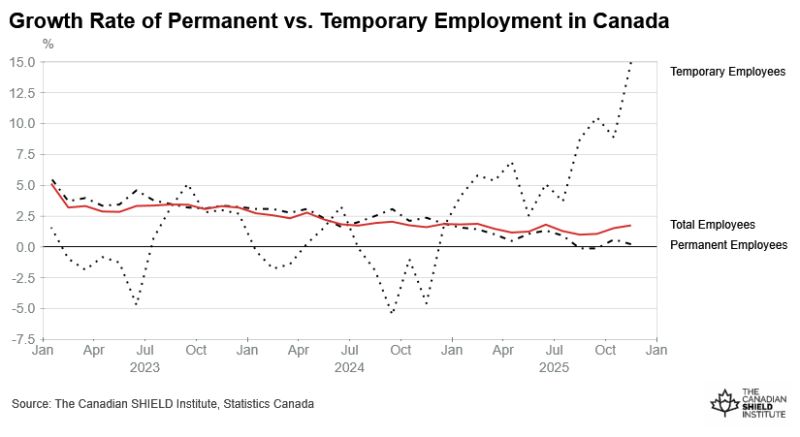
The Job Security Myth: Perception vs Reality
Ask most Canadian job seekers about job security, and they will tell you permanent direct hires offer ironclad protection while agency placements are pure volatility. That perspective makes sense on the surface, but it oversimplifies how Canadian labour law works in practice.
In Canada, non-unionized private sector roles never come with lifelong guarantees. Provincial employment standards operate on the doctrine of dismissal without cause. As long as your employer avoids discriminatory firings prohibited under human rights codes (such as disability, age, gender, or race) and does not retaliate against you for exercising statutory rights, they can end your direct employment whenever they see fit. They simply have to provide reasonable working notice, termination pay in lieu of that notice, and statutory or common law severance pay.
Why do Canadian workers still treat direct hire as far more secure? The difference comes down to administrative friction and termination economics. Dismissing a permanent direct hire costs an employer significant time and money. Under common law precedents set in Canadian courts, an employer terminating a direct hire without cause must provide reasonable notice. Depending on your age, length of service, seniority, and local labour market conditions, that compensation often climbs well past provincial statutory minimums. HR teams must also draft termination letters, coordinate offboarding, calculate vacation payouts, and manage the hit to company morale.
Ending an agency contract involves none of that friction. The host company never conducts a formal layoff; a manager simply instructs the agency account representative that the project has concluded. Because you are not the host company’s employee, they carry zero common law severance liability toward you.
Labour organizers and legal clinics have repeatedly brought the vulnerabilities of this triangular relationship to federal policymakers. In its review of contingent employment across Canadian workplaces, Employment and Social Development Canada documented the precarious position workers face when placed through intermediary firms:
Two advocacy groups told us that temporary help agency employees, for example, are vulnerable because of the triangular relationship that exists between the employee, the agency and the client company. They said that these employees are more likely to receive lower pay and face an increased risk of workplace injury, job instability, unpredictable hours and barriers to permanent employment.
Source: Employment and Social Development Canada, What We Heard: Modernizing Federal Labour Standards
Direct employment creates financial speed bumps that shield workers from sudden, spur-of-the-moment terminations. Staffing agency arrangements deliberately remove those speed bumps so client companies can scale headcount up and down with daily market demand.
5 Key Dimensions: Staffing Agency vs Direct Hire Compared
To figure out which path actually serves your long-term plans, you need to set the two models side by side across pay, health benefits, promotion routes, legal safety nets, and the requirements of everyday life.
| Evaluation Dimension | Staffing Agency Route (Temp / Assignment) | Direct Hire Route (Internal Payroll) |
|---|---|---|
| Compensation Structure | Hourly wage with no bonus participation; potential bill-rate spread of 20% to 50% deducted by agency. | Annual salary or base hourly pay; bonus eligibility, profit sharing, and structured annual merit increases. |
| Benefits & Sick Leave | Vacation pay typically cashed out at 4% to 6% per paycheque; rarely includes extended health, dental, or RRSP matching. | Comprehensive extended health, prescription drugs, dental, paramedical, life insurance, and corporate RRSP/pension matches. |
| Legal Status & Severance | Triangular relationship; host employer has no severance liability; termination of assignment does not trigger termination of employment with agency. | Bilateral employment relationship; protected by provincial statutory notice minimums and extensive Canadian common law reasonable notice. |
| Advancement & Skill Building | External observer status; limited access to internal training portals, leadership development, or promotion pathways. | Full onboarding, mentorship, internal tuition reimbursement, and access to internal postings before external public advertising. |
| Permanent Residency & Credit | Assignment work can complicate Provincial Nominee Program (PNP) applications; Canadian banks scrutinize non-permanent hours during mortgage underwriting. | Stable full-time indeterminate offer letters satisfy Express Entry, provincial nominee streams, and bank mortgage stress tests. |
1. Compensation Structures and the Bill-Rate Spread
When an employer creates an internal role, they budget for total payroll cost. That figure covers base pay, mandatory employer contributions for CPP and EI, provincial workers’ compensation premiums, statutory holiday pay, group insurance coverage, and annual bonuses.
When the same business brings in a staffing agency, they pay a single flat hourly bill rate. Say the agency charges a host client $42 an hour for an administrative assistant. The placement worker typically takes home between $24 and $27 an hour. The spread covers the agency’s internal overhead, statutory payroll costs, and profit.
Federal wage data on the government’s Job Bank shows the national median hourly wage for an administrative assistant in Canada sits at $26.44. In major urban centres like Toronto, that median reaches $26.67, with senior workers earning more than $37.95 an hour. When an agency brings you in at an entry assignment rate, you often land in the lowest quarter of local wages, even though the company using your labour is spending what it would take to hire somebody in the upper half of the market.
Direct employees also take part in standard annual salary reviews. Even at conservative firms, permanent staff see scheduled cost-of-living adjustments, merit increases, or quarterly performance bonuses.
Agency contractors almost never see a raise while on assignment. If local living costs climb over a twelve-month contract, your agency cannot adjust your hourly pay without opening up its commercial contract with the host client. Most agencies simply refuse to ask. Your hourly rate stays flat while the direct employees sitting beside you receive regular step increases.
If you find yourself preparing for wage discussions, knowing how to handle the salary expectations question in Canada makes a substantial difference. In a direct interview, you negotiate your compensation with the person who holds the budget. In an agency arrangement, you negotiate with an intermediary whose firm keeps whatever part of the client bill rate does not go to you.
2. Benefits, Paid Leaves, and Provincial Employment Standards
Healthcare spending creates one of the starkest divisions between agency work and direct employment.
Provincial healthcare plans, including OHIP in Ontario, MSP in British Columbia, and AHCIP in Alberta, fund hospital care and visits to a physician. They do not cover prescription medications, routine dental care, major dental procedures, prescription glasses, physiotherapy, or registered massage therapy. For working families, those routine healthcare bills routinely run into thousands of dollars each year.
Direct positions, especially salaried office jobs and union trades, come standard with group health and dental plans. Employers generally cover 70% to 100% of these premium costs once you complete an initial three-month waiting period. Many companies also run registered retirement savings plan (RRSP) matching programs, matching between 3% and 6% of your gross pay.
Staffing agencies rarely offer employer-funded group health plans to assignment workers. A few large agencies provide voluntary access plans where you can buy into basic insurance, but you pay the entire premium yourself through regular payroll deductions.
Vacation pay works very differently too. Provincial employment standards laws establish minimums across the country:
- Workers have a legal right to at least two weeks of paid annual vacation (calculated as 4% of gross pay), which increases to three weeks (6%) once you hit specific service thresholds, such as five years in Ontario, or similar tenure milestones in other provinces.
- Direct hires earn this benefit as bankable paid time off, which lets them take two full weeks away during the summer while their regular paycheque arrives on schedule.
- Agencies almost always choose to pay out that 4% vacation entitlement directly on every bi-weekly pay stub. That adds a few dollars to your pay each week, but the day you take time off for a family trip or an office holiday shutdown, your cash flow drops straight to zero.
When you weigh two options, a $30-an-hour direct position that includes 80% dental reimbursement, prescription coverage, paid sick days, and a 4% RRSP company match leaves you considerably farther ahead than a $34-an-hour agency contract where you must cover every filling and private prescription bill on your own.
Federal rules have started addressing some of these gaps. If your career sits in a federally regulated industry such as banking, telecom, or interprovincial trucking, reviewing the equal pay rules for temporary workers will show you whether your current assignment package matches federal equal treatment requirements.
3. Statutory Severance, Termination Protections, and Common Law
The payout and notice you receive after losing a job depend on how your working relationship is structured in law.
When a company lets a permanent direct hire go without cause, provincial employment laws provide an absolute minimum floor for severance and notice. Under Alberta’s Employment Standards Code, for example, an employer must give one week of written notice or equivalent termination pay after ninety days on the job, rising to two weeks after two years, and scaling up to eight weeks once you reach ten years of continuous employment.
Non-union direct employees in Canada can also pursue common law reasonable notice. Provincial courts calculate reasonable notice by weighing the “Bardal factors”, which include your length of service, your age, the character of your role, and how difficult it will be to find comparable work given your qualifications and background. For long-term or senior team members, common law compensation often amounts to roughly one month of regular pay per year of service, reaching 24 months or more in substantial claims.
Agency assignment workers occupy a separate legal category. When a host company tells an agency worker that their services are no longer needed on a project, employment standards law does not consider that an official dismissal. Your employer is the staffing agency, not the client whose office you walked into every morning.
Because the staffing firm can simply leave your file open on its candidate database and suggest other possible assignments, your employment remains active in the eyes of the law. You do not qualify for statutory termination pay simply because a specific placement has run its course.
Certain provinces have put rules in place to stop firms from exploiting this arrangement. Ontario’s Employment Standards Act, specifically Part XVIII.1, requires temporary help agencies to provide assignment employees with at least one week of written notice, or termination pay instead of notice, whenever an assignment expected to run three months or longer gets cut short without cause. Even so, the agency avoids paying that notice if it can offer the worker a reasonable replacement assignment at similar pay and a comparable location starting straight away.
If an agency finally ends its overall business relationship with you, it only owes statutory termination pay based on the full continuous duration you spent active on its candidate roster. The value or duration of the client placement where you performed your day-to-day duties does not dictate the calculation. Securing common law reasonable notice against a temp agency is exceptionally difficult, meaning assignment workers rarely receive anything beyond basic statutory minimums.
4. Career Progression, Training, and Skill Stagnation
A sustained period working on agency assignments creates serious hurdles for career growth. Permanent hires receive dedicated onboarding when they join an organization. Companies put their internal staff through structured training schedules, internal safety programs, software certifications, and specialized business processes.
Employers direct money and time into permanent staff because holding onto institutional knowledge saves capital over the long run. Direct workers have regular access to company communication channels where internal job openings, department transfers, and formal mentorship tracks get published weeks before HR posts them to the public.
Agency workers, meanwhile, are hired to complete immediate project demands. The host firm expects you to step in and handle your daily assignments with almost no onboarding. You will rarely find yourself invited to quarterly planning sessions, cross-department task forces, or enterprise software workshops.
This division can stall your professional development. You might spend two full years processing vendor invoices or verifying records inside a large manufacturing facility, but because your paycheque came from an external agency, the company never offered you training on its core enterprise resource planning (ERP) governance tools or gave you the chance to run process improvements. When the client winds the placement down, your work history shows basic transactional maintenance instead of genuine career growth within a company.
Whenever you prepare your resume for Canadian hiring managers, making sure it outlines concrete accomplishments is what gets attention. Taking time to study the details of a one-page vs two-page resume in Canada will ensure your daily duties read as genuine professional impact, whether you spent that period on an agency contract or on a direct company payroll.
5. Immigration, Work Permits, and Financial Milestones
If you are a foreign national pursuing Canadian permanent residence (PR), picking between an agency contract and a direct hire offer can reshape your immigration outcome.
Under the federal Express Entry process, individuals applying through the Canadian Experience Class (CEC) must demonstrate at least one year of continuous full-time, or equivalent part-time, paid Canadian work experience in a qualifying National Occupational Classification (NOC) TEER category (TEER 0, 1, 2, or 3) during the three years prior to submission.
Agency assignment hours can meet the standard for CEC credit so long as your daily duties align with an eligible TEER category and you carry a valid, open work permit, like a Post-Graduation Work Permit or an International Experience Canada working holiday visa. The paperwork requirements, however, are far heavier.
Officers with Immigration, Refugees and Citizenship Canada (IRCC) expect detailed employment reference letters confirming your specific daily job responsibilities, hourly pay rate, weekly hours, and management reporting structure. Many staffing agencies only agree to produce generic letters listing your job title, hourly rate, and assignment dates, declining to certify your day-to-day work tasks because agency coordinators do not supervise your daily output on the client site.
Provincial Nominee Programs (PNPs) present an even higher bar. Multiple provincial streams, such as the Ontario Immigrant Nominee Program (OINP) Employer Job Offer streams and the Alberta Advantage Immigration Program (AAIP), demand an indeterminate full-time job offer from an operating employer based in the province. In many of these application categories, staffing agency contractors are outright disqualified, because provincial criteria view the placement firm as an employment broker rather than an operating business hiring an end-user employee.
Outside of immigration filings, your daily financial planning in Canada depends heavily on predictable income. If you go to a lender for a car loan or apply for a home mortgage subject to the federal stress test rules from the Office of the Superintendent of Financial Institutions (OSFI), underwriters will ask for verification letters and recent pay documentation.
When a mortgage underwriter reviews an employment confirmation from an established corporate entity showing an indeterminate permanent salary, approval follows a standard process. When they get a letter from a temporary placement firm stating that your current role is a short-term assignment with a scheduled completion date, financial institutions treat your pay as variable contract revenue. In that situation, banks usually demand your past two years of Notice of Assessment (NOA) records from the Canada Revenue Agency (CRA) so they can calculate a multi-year average, which often limits your borrowing capacity or forces you to supply a substantially larger cash down payment.
The Conversion Trap: What Happens When a Temp Role Goes “Permanent”
Recruiters love selling contingent contracts under the “temp-to-perm” label. The promise sounds straightforward enough: you work through the agency for three to six months, show everyone that you do good work and get along with the team, and then the client brings you onto internal payroll.
While that does happen, plenty of Canadian job seekers get stuck in what labour advocates call “perpetual probation.”
Conversions stall because of the commercial contract between the staffing agency and the host employer. That agreement usually spells out strict non-solicitation rules and a schedule of conversion fees. If the client wants to put you on their own payroll before an agreed evaluation period wraps up, they have to pay a buyout fee (sometimes called a liquidation or conversion fee). That penalty typically runs from 15% to 25% of your projected first-year salary, which means thousands of dollars out of pocket.
Other contracts require an agency worker to log 600, 800, or 1,000 billable hours before the employer can hire them without paying a fee. If a company runs on tight quarterly margins, cutting a $10,000 cheque to bring an administrative assistant or customer service worker in-house makes little financial sense. It costs the manager less trouble and money to simply extend the monthly agency purchase order and pay your bill rate out of a temporary project budget.
Some provinces have stepped in to stop agencies from locking workers down indefinitely. In Ontario, Part XVIII.1, section 74.8 of the Employment Standards Act sets hard legal limits on conversion fees:
- A temporary help agency cannot prohibit a client from hiring an assignment employee directly.
- A temporary help agency can only charge a client a conversion fee during the first six months beginning on the day the employee first started working on assignment for that specific client.
- After that six-month window has elapsed, the agency is legally prohibited from charging any conversion fee whatsoever.
Even with those protections, corporate budgeting can still derail a hire. Companies treat full-time headcount very differently from temporary operational spending. A department head might hold full authority to spend $50,000 on contract staffing out of operating expenses, yet possess zero authority to open an approved full-time employee (FTE) headcount requisition, which demands sign-off from senior leadership or executive HR.
If an agency pitches you an assignment on the premise of a permanent job down the road, verbal assurances are not enough. Put these specific questions to the recruiter:
- What is the exact number of hours required for fee-free conversion under your client agreement?
- Does the client have an approved, open FTE headcount slot currently allocated for this seat?
- Has this specific department converted an agency contractor to direct payroll in the past twelve months?
When recruiters dodge those questions or offer vague lines about seeing how things develop, treat the gig as temporary. It probably will not become anything else.
Actionable Checklist: Which Pathway Matches Your Current Situation?
Deciding between agency contracts and direct hire comes down to your bank account, career stage, and Canadian residency plans. Use this checklist to see which path fits your situation today.
Pursue the Staffing Agency Route If:
- You have an immediate cash runway emergency. If you have under 30 days of living expenses left, waiting through a multi-stage corporate hiring process is not an option. Agencies can place you into paid shifts within days.
- You are a recent newcomer needing local Canadian work experience. Plenty of Canadian employers discount foreign credentials, however unfair that is. Contract placements get domestic company names, localized systems, and local references onto your resume quickly.
- You are testing an industry transition. Pivoting from hospitality into corporate administration or from retail into supply chain logistics takes adjustment. Short-term contracts give you a low-risk setting to learn operational vocabulary and workplace conventions.
- You require schedule flexibility. When you are balancing family caregiving or part-time university coursework, short contingent assignments let you work for a spell and step away between contracts without hurting your career trajectory.
Hold Out for Direct Hire If:
- You are pursuing permanent residency through employer-driven PNP streams. When your path to permanent residence relies on an approved, indeterminate provincial nomination, agency temp work can disqualify you entirely. Focus on direct-hire employers ready to support your provincial registration.
- You manage significant ongoing healthcare expenses. If you or your dependents need monthly maintenance prescriptions, dental procedures, or ongoing therapeutic services, an employer-paid group benefits plan will easily outweigh temporary hourly premiums.
- You are planning a residential property purchase in Canada within the next 18 months. Canadian mortgage underwriters scrutinize non-permanent employment closely. An indeterminate direct hire offer letter gives banks the stability they look for under standard lending rules.
- You have established mid-to-senior domain expertise. If you have more than three to five years of specialized experience, taking agency contracts can devalue your market positioning. Your background calls for full compensation packages, incentive plans, and internal advancement.
If you are weighing several paths or updating your materials for corporate hiring managers, a professional resume assessment can help position your accomplishments clearly and bypass agency screening tiers altogether.
How to Protect Yourself When Working With Canadian Staffing Agencies
Taking an agency placement to keep cash coming in makes sense when bills are due, but you do not have to accept poor treatment. A few straightforward habits will protect your rights and your pay.
Start by verifying that the agency holds a valid licence. In Ontario, the Employment Standards Act requires all temporary help agencies and executive recruiters to be licensed. Dealing with an unlicensed shop exposes you to wage errors, dodgy contracts, and cancelled assignments without any provincial recourse. You can check an agency’s status on the public licensing registry hosted by Employment Ontario.
Next, draw a hard line on recruitment fees. Across Canada, including Ontario, British Columbia, and Alberta, provincial employment standards make it illegal for an agency or recruiter to charge candidates for finding work, reviewing a resume, or setting up an interview. Client companies pay those costs. If a recruiter asks for a registration fee, a screening surcharge, or an onboarding deduction from your wages, walk away immediately.
Keep your own shift records as well. Relying solely on a staffing agency app is risky if data goes missing or gets entered wrong, so log the details yourself:
- Exact start and end times for every shift.
- The names of client supervisors directing your daily tasks on site.
- Any breaks taken along with overtime hours worked.
- The specific equipment, software, and responsibilities you handled each day.
These personal notes give you real backing if a pay dispute comes up later. When overtime goes unpaid or vacation pay is miscalculated, provincial labour laws make the agency and the host company jointly liable for your statutory wages. Having your own record helps you collect every dollar you worked for.
Finally, use the placement as temporary income while you push for direct-hire roles. Keep marketing yourself on evenings and weekends, attend industry events, follow hiring shifts through reports like the September 2026 Labour Force Survey, and continue sending applications straight to employers.
Where Real Job Security Truly Comes From in Canada
A signed contract cannot guarantee your security, whether that document comes from a staffing agency or a corporate direct hire.
Direct-hire jobs still hold the advantage on paper. They provide statutory and common-law termination protections, employer-funded health benefits, and company-matched retirement contributions. They also make qualifying for a Canadian mortgage and applying for permanent residency considerably simpler. If your savings give you the runway to hold out for a direct role, that path offers far better long-term footing.
Even so, an indeterminate contract can dissolve without warning. A corporate merger, a leadership shakeup, or a sudden restructuring can end your role with nothing more than a termination letter and a severance cheque.
Your real protection is portable market value. That means keeping your skills sharp, staying connected with peers across Canadian industries, and knowing your statutory rights under provincial labour legislation. It also means knowing how to present your background directly to hiring managers who control operational budgets.
Staffing agencies make sense when you need immediate income, fast placement, or initial Canadian workplace exposure. Beyond that, aim for direct employment that protects your health, invests in your future, and gives your life in Canada dependable stability.
Key takeaways
5
- Staffing agency employment creates a triangular relationship where the agency remains the legal employer while the host client directs daily work on site.
- Direct hire employees receive common law reasonable notice and statutory severance protections that host employers do not owe to temporary agency assignment workers.
- Staffing agencies deduct operating margins from client bill rates and rarely provide employer-funded extended health benefits or retirement contribution matches to assignment workers.
- Indeterminate direct hire offer letters satisfy mortgage stress tests and provincial nominee programs, whereas temporary agency assignments face strict scrutiny from lenders and immigration programs.
- Ontario law prohibits temporary help agencies from charging conversion fees after an assignment employee has worked for a client for six months.
Frequently asked questions
5
Why do direct hire roles offer stronger termination protection than staffing agency roles in Canada?
Direct hire roles provide stronger termination protection because Canadian operating employers carry legal liability for statutory termination pay and common law reasonable notice. When a host company ends an agency placement, the assignment concludes without triggering a formal dismissal from the agency itself. Host businesses owe no severance pay to agency staff, whereas permanent direct hires terminated without cause often qualify for substantial notice periods based on age, service length, and position.
Can staffing agency assignment hours count toward Canadian permanent residency?
Staffing agency work hours can count toward the Canadian Experience Class under Express Entry if the duties match an eligible National Occupational Classification TEER category and the worker holds a valid open work permit. Many provincial nominee programs, however, disqualify agency workers because they require an indeterminate job offer from an operating business. Staffing agencies also frequently decline to provide detailed reference letters verifying daily tasks, which can complicate federal immigration reviews.
How does vacation pay differ between direct hires and staffing agency workers in Canada?
Vacation pay for direct hires typically accumulates as bankable paid time off, allowing employees to maintain regular earnings while taking annual leaves. Staffing agencies almost always pay out the statutory four percent vacation pay entitlement on every bi-weekly pay stub instead. While this practice increases regular cash payments slightly, agency workers receive zero income when taking personal time off or during client holiday facility shutdowns.
Is it legal for a Canadian staffing agency to charge workers placement fees?
Canadian staffing agencies are legally prohibited from charging job seekers fees for finding work, reviewing resumes, or scheduling interviews under provincial employment standards legislation in provinces such as Ontario, British Columbia, and Alberta. Client employers pay all recruitment and placement charges. Workers who encounter an agency requesting registration fees, screening charges, or mandatory payroll deductions for placement services should immediately decline and report the firm to provincial authorities.
What is a temp-to-perm conversion fee in Canada?
A temp-to-perm conversion fee is a contractual buyout penalty that a host employer pays to a staffing agency to transition an assignment worker onto internal company payroll. This fee typically ranges between 15 percent and 25 percent of the worker's projected first-year salary. In Ontario, the Employment Standards Act bans agencies from charging these buyout fees after the worker completes six months on assignment with the client.
Upcoming career fairs
Career fairs in Ontario
Hire Canada Job Fair & Training Expo
- In person
- Free
OAC Career Fair - October 2026
- In person
- Free
Level Up! Skilled Trades Career Fair - Timmins
- In person
- Free
Listings are gathered each month from public event pages. Confirm the details with the organizer before you go.
More From the Blog
World Mental Health Day: Workplace Mental Health in Canada
Discover how workplace mental health in Canada is evolving after World Mental Health Day 2026, including accommodation rights and burnout...
Read the articleHow to Use the September 2026 Labour Force Survey to Target In-Demand Roles: A Step-by-Step Tutorial
Learn how to use the September 2026 Labour Force Survey to identify growing sectors, bypass sluggish fields, and land Canadian jobs in Q4...
Read the articleGoogle Gemini Agent: What It Means for Canadian Knowledge Workers
Google Cloud launched its enterprise Gemini agent on October 8, 2026. Here is what Canadian knowledge workers must do to protect their...
Read the articleReady to Launch Your Career Marketing Campaign?
Book a strategy call and see how Nainly can transform your job search.
Schedule a CallFree consultation. No commitment.