On this page
- What “high-paying jobs in Canada” means under the new rules
- How the new Express Entry points fit together
- Which high-wage occupations are on the list?
- Match your NOC to your duties, not your preferred outcome
- Build a job-search plan around work you can defend
- What a qualifying job offer needs from your employer
- Keep your work permit separate from your permanent residence plan
- Update your Express Entry profile without guessing
- Choose better employment, not just a more attractive points theory
- Watch for promises that turn immigration pressure into a sales tool
- What Canadian workers should take from the hiring implications
- Build a plan that still works when the headline fades
- In brief
- Key takeaways
- Frequently asked questions
Canada announced its Express Entry overhaul on October 16, 2026, setting the changes to take effect on November 3, 2026. The news reports circulating about the policy were published on October 18, two days after the official release. Under the new policy, workers pursuing high-paying jobs in Canada can gain additional CRS points through qualifying job offers or eligible Canadian work experience in designated occupations. Even so, earning a high wage does not automatically open a permanent residence pathway. IRCC’s announcement sets out the changes and implementation date.
The practical question is whether your day-to-day duties fit an eligible occupation and whether you can back up those requirements with solid documentation. That focus might feel less exciting than headlines promising bonus points, but it is a much better footing for any Canadian job search.
If you are already working in Canada, hold off on resigning, bargaining for an inflated title, or jumping at an odd job offer just because someone claims it will fix your immigration status. Review your actual occupation code, your employment records, and your current work permit first. Then you can weigh whether changing employers really helps your position.
This guide outlines the career implications of the published rules. It cannot substitute for specific immigration advice, especially if your permit status, professional registration, or employment arrangements are complicated.
What “high-paying jobs in Canada” means under the new rules
In everyday conversation, a high-paying job is simply one that pays well. Under this Express Entry change, points depend on the wage bracket assigned to your occupation; your personal pay stub does not set the classification.
The Sun’s October 18 coverage makes that distinction clearly:
The classification is based on the median wage for each occupation across the country, rather than the salary earned by an individual applicant.
Source: The Sun, Canada’s new immigration rules: Full list of eligible high-paying jobs
Keep that distinction in mind before you start salary discussions. Do not treat a pay bump as an Express Entry points strategy. You negotiate higher compensation because your responsibilities, performance and market value justify it, but confirming which occupation code matches your day-to-day duties is a separate job.
If an employer gives you a raise while your day-to-day tasks stay the same, check your occupational code before assuming you have earned extra immigration points. That caution applies just as much if you are offered a grander job title without any real change in duties, because wording on an offer letter will not rewrite what you do.
When mapping out your career, set up two distinct columns. The compensation column belongs to base pay, benefits, overtime arrangements, pension contributions, commuting costs and job stability. The immigration column tracks your occupation, its specific requirements and the documentation you must gather.
Our guide to answering the salary expectations question in Canada can help you through the salary side of that equation. Anchor those conversations to the work you perform, rather than guessing that a specific dollar figure will boost your CRS score.
How the new Express Entry points fit together
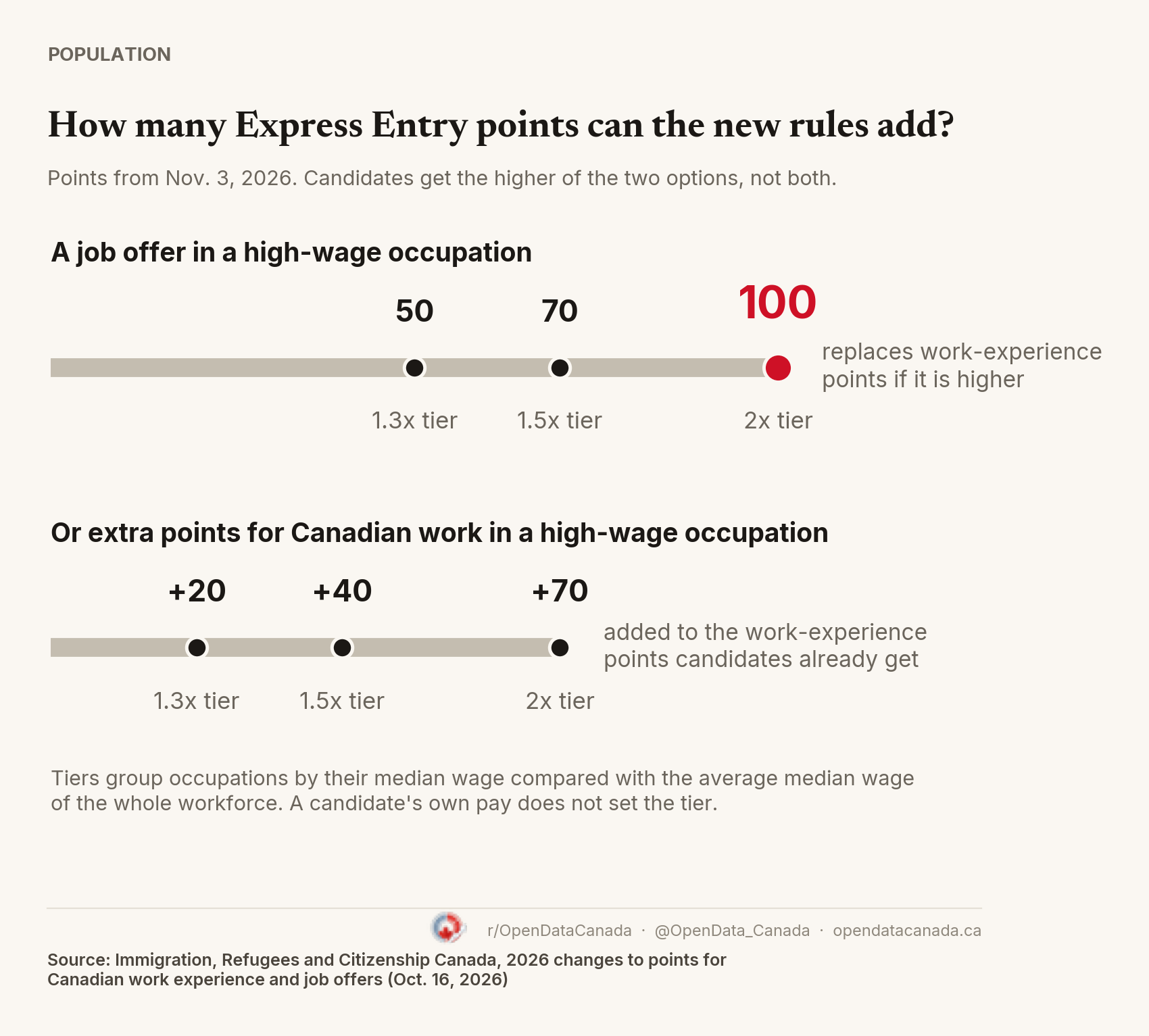
For qualifying job offers, the points depend on published occupational wage levels. You earn 100 CRS points when an occupation reaches at least twice the workforce median wage, 70 points at least 1.5 times, and 50 points at least 1.3 times. These benchmarks belong to the occupation itself, independent of whatever wage you negotiate individually. IRCC’s high-wage backgrounder provides the scoring schedule.
Eligible Canadian experience follows a separate schedule to supplement your duration-based points. At least 12 months in the highest occupational band can bring 70 additional points. Qualifying experience across the middle band or above brings 40, or 20 across eligible high-wage occupations, depending on which criteria you meet. IRCC does not combine the job-offer and experience streams; the system awards whichever produces the higher score. Under the labour market integration cap, the maximum is 150 points without an accompanying spouse or partner, or 140 with one. The same backgrounder explains these limits and the non-stacking rule.
Because those streams do not stack, never simply tack a headline offer number onto your existing score. You have to recalculate the complete profile.
Before making a career choice, write down the path you plan to claim and the evidence you have to back it up. If your math hinges on an assumption you cannot clearly justify, treat it as unresolved. IRCC’s earlier explainer helps you understand the overall framework, but consult the current written rules for the actual scoring details.
Do not let an online calculator act as your immigration adviser. A calculated score is only as reliable as the details behind it. Keep track of your assumptions so you can review them whenever your work experience, job offer, or family situation shifts.
Which high-wage occupations are on the list?
The official list covers plenty of ground past executive suites and specialist doctors. Financial managers sit in the top wage band. Software engineers and designers, construction managers, and registered nurses and registered psychiatric nurses sit in the middle band. Financial auditors and accountants appear in the lower eligible tier. These occupations are only examples, and closely related titles often carry different classifications. Always check the exact entries on IRCC’s official high-wage occupations list.
Treat those examples as a prompt to dig deeper. If you are exploring software engineer roles, start by cataloguing the work you actually do each week. Technical roles rarely fit into one neat box, so separate your systems design, development, testing, support and team management duties before deciding which code fits best.
Finance demands the same precision. When you look at an accounting job in Canada, review the specific credentials and daily duties for that exact post, since finance job titles vary wildly across companies.
Build your target list around positions you can defend. For any prospective role, ask yourself if you could explain your technical decisions and everyday problem-solving in a detailed interview. A past manager should be able to corroborate that same story without hesitation. When your experience does not quite line up, do not build an immigration strategy around a title simply because the points look appealing. A sound career move holds up under scrutiny from both a hiring team and a visa officer without needing two different versions of your resume.
Match your NOC to your duties, not your preferred outcome
Pay close attention to the National Occupational Classification, or NOC, before drafting your resume.
IRCC gives direct guidance here:
Make sure the main duties listed match what you did at your job.
Source: IRCC, Find your National Occupational Classification
Take that instruction at face value. Start with the daily work, then identify the right classification. Picking an attractive points category and working backward from it will land you in trouble.
Open a blank document and describe an ordinary work week in plain language, skipping corporate buzzwords. Write down what you review, build, approve, troubleshoot, reconcile, supervise, or deliver. Include the decisions you own and the ones that require someone else’s approval.
Then compare your notes with the official occupation descriptions. It is tedious work, but do it anyway.
If your employer calls you an operations manager while your week mostly involves scheduling appointments, maintaining records, and processing routine requests, look past the title. Ask which occupation captures the substance of what you do.
By the same token, do not write off substantial management duties simply because your employer uses an understated internal title. Document the authority you actually exercise, then research the classification that fits.
For mixed roles, maintain a working record covering:
- Your recurring duties, decision-making authority and reporting relationship.
- The employment documents and supervisors that can confirm those responsibilities.
- Any material changes in duties, along with when those changes occurred.
Treat this strictly as an evidence exercise.
You can help your employer prepare an accurate reference letter by providing a factual summary of your work. Avoid asking them to copy an official occupational profile that misrepresents your job. If the classification remains ambiguous, bring your actual workplace documents to an authorized immigration professional.
That consultation will be much more useful with a coherent work history in hand.
Build a job-search plan around work you can defend
Once you identify occupations that make sense on paper, you still have to deal with the hiring manager.
Your resume needs to show why an employer should hire you, well before it touches on immigration plans. Lead with relevant duties, useful skills, and evidence of sound judgement. Keep your PR planning notes out of the document you submit.
For a finance position, you might explain how you investigated reconciliation issues, tightened reporting controls, or walked non-finance colleagues through complex numbers. For a tech role, talk about diagnosing a system failure, weighing design trade-offs, or coordinating a deployment. Stick to examples you can talk through honestly.
Resist inventing performance metrics just because conventional resume advice demands a number in every line. A clear account of a difficult issue and how you handled it is worth far more than an inflated percentage you cannot substantiate.
Draw your interview answers from that same evidence. Walk through what was happening, what you were personally responsible for, where your judgement came in, and what changed because of your effort. Keep employer confidential information out, but leave enough specifics that your contribution is obvious.
Be realistic about where you stand today versus longer-term goals. If a role demands capabilities you have not built yet, set up a learning plan instead of relabelling past experience. Read actual job postings before spending money on training. Note the requirements that keep coming up, compare them to your track record, and pick coursework that closes a genuine skill gap. That gives you something real to explain to an employer, which matters much more than collecting credentials that merely mimic immigration headlines.
What a qualifying job offer needs from your employer
The new rules remove the LMIA requirement for qualifying Express Entry job offers, but IRCC still checks whether the position is genuine. Offers can cover an existing job or a new position, provided a written document sets out duties, pay, and employment conditions. A work permit alone is never a job offer. Review IRCC’s job-offer requirements and transition instructions.
Do not assume any quick employer note will do. When you approach HR, ask to review how your real arrangement is documented. Bring your current contract, official job description, and a concise summary of your duties. Explain what you need confirmed without expecting HR to guarantee an immigration result.
A practical opening keeps things grounded: “I’m reviewing how my employment should be documented for Express Entry. Could we confirm my current duties, employment terms and who can provide an accurate supporting letter?” That gives HR a manageable request, whereas asking whether the company can deliver permanent residence is not.
Find out who holds the authority to confirm an ongoing offer. A direct manager might know your daily work well but lack the authority to commit the organization to future employment. If your role depends on project funding or a client contract, discuss that openly rather than hoping IRCC overlooks it.
For employers, our advice is to keep the business decision separate from the immigration assessment. Settle what work the organization genuinely needs, what terms it can support, and whether the candidate is qualified. Then seek proper advice on the immigration side. Never reshape a role on paper just to look favourable. Documenting a real contribution builds a far stronger foundation than an elaborate, untested promise.
Keep your work permit separate from your permanent residence plan
A revised points system does not alter your present legal permission to work in Canada. IRCC makes this plain in its guidance for candidates in the Express Entry pool:
Don’t work in Canada without status. It can make you ineligible for Express Entry.
Take that reminder seriously as you map out your career. Track when your current permit expires, the conditions stamped on it, and any pending authorization you rely on. Optimism about an invitation round will never substitute for verifying what you can legally do today.
Switching employers on a closed permit brings up distinct authorization rules, and even open work permits carry conditions you have to monitor. Review IRCC’s guidance on extending or changing work-permit conditions well before you commit to a move.
Map out the sequence before resigning from your current job. Figure out which approvals must clear before your first day, who handles each document, and whether the new employer can accommodate a shifting start date. Get professional advice if your plan depends on maintained status, a pending application, or a public policy.
Never rely on a recruiter’s informal reassurances about your status, even when they mean well. Ask which official regulation backs up any claim, and have a qualified professional review your file when needed. In your own notes, keep separate records for your current work authorization, your Express Entry profile, and your job search. That separation keeps you from confusing momentum in an interview process with actual legal clearance to work.
Update your Express Entry profile without guessing
IRCC says existing profiles will be recalculated when the changes take effect, and invitation rounds will pause during that window, which may take up to two weeks. If you want job-offer points, IRCC advises adding the required information before November 3, 2026. Because online fields will not immediately reflect the new rules, the job-offer page includes specific transitional instructions. Follow IRCC’s published profile-update instructions closely.
Before you alter anything, assemble your paperwork. Check employment dates against your records, confirm the employer’s legal name, and review how promotions or shifts in responsibility are described. Look for inconsistencies across your resume, employment letters, and profile. This is an administrative review, so keep your duties accurate instead of puffing them up to sound senior.
When you discover a discrepancy, investigate it. Perhaps a resume rounded a date for readability, or an employer used an internal title that needs explanation. Note what happened and obtain the correct documentation to clear it up.
Save copies of everything you submit and the official instructions you followed. Keeping a short change log explaining what you updated and why feels tedious, but it is invaluable when you need to reconstruct a decision later.
Separate details you have verified from anything you are still waiting to confirm. A note that says “HR checking employment terms” is honest and useful; treating an unsigned draft as a final offer creates trouble. If a representative handles your profile, read through every entry yourself and ask questions until you understand every claim made in your name.
Choose better employment, not just a more attractive points theory
An immigration advantage is never a reason to skip basic due diligence on a job.
Before accepting an offer, examine the reporting structure, workload, probation terms, benefits, location, and room to grow. Ask why the position is open, how the team defines success, and speak plainly about any scheduling or relocation limits. Then test the role against a slower timeline: would you still want this job if your immigration outcome took longer than expected?
If you live in Calgary and consider a role elsewhere, evaluate the full household impact. Factor in moving costs, your partner’s work, childcare arrangements, commuting, and the support network you would leave behind. Write down those trade-offs before deciding that a different occupation is automatically a better choice.
With contract work, clarify who employs you, how assignments are funded, and what happens between projects. Our discussion of staffing agency versus direct hire in Canada helps frame those employment questions.
Be cautious about an internal promotion that changes your title without giving you the authority, training, or support to do the job. Ask which responsibilities will transfer to you and how management evaluates your performance.
Your best next move might be a different employer, but it could just as easily be a clearer role, stronger documentation, or better development opportunities where you already work. Check those details before assuming that movement itself is progress.
Watch for promises that turn immigration pressure into a sales tool
Treat any promise of a guaranteed result as an immediate red flag. Official rules require an officer’s assessment, and nobody can sell you a shortcut around that.
Our view is straightforward: pay for professional work, never for a promised outcome. You need to know who handles your file, what they deliver, and what proof backs up their claims.
A few warning signs should make you pause:
- Demands to pay for a job offer without a genuine interview or a clearly defined role.
- Instructions to inflate duties, conceal employment facts, or sign paperwork you know is inaccurate.
- Suggestions that a title or a fee excuses you from meeting published criteria.
If a pitch turns pushy, walk away. Save every email, then get an independent second opinion.
Before paying anyone for immigration advice, verify their credentials with the proper regulator. Get a written contract detailing their scope of work, and confirm what stays your responsibility.
IRCC publishes plain guidance on choosing an authorized representative and protecting yourself from fraud.
Employers should avoid claiming that a job guarantees permanent residence. Describe the role honestly and leave immigration decisions to the proper review.
Workers need to keep their own copies of job contracts, pay records, and submitted forms. Never surrender your career decisions just because someone claims to know a backdoor route.
A credible adviser explains uncertainty plainly, without turning your anxiety into pressure.
What Canadian workers should take from the hiring implications
Canadian citizens and permanent residents can treat this announcement as a prompt to review their positioning. Government policy lists are never personal career roadmaps, and they do not signal that an occupation has suddenly become easy or impossible to enter.
Pull up current postings in the cities where you want to work. Study the responsibilities, credentials, and experience employers ask for, compare them with your own track record, and concentrate your effort where you have solid backing.
Employers face a similar reality: immigration policy cannot replace a clear job description, realistic compensation, or competent hiring. When a position sits vacant, dig into why. Ask applicants what feels unclear about the role, and check whether the formal requirements truly match the day-to-day work.
For internationally trained professionals, eligibility on paper is distinct from readiness for a specific opening. Confirm any licensing, registration, or credential requirements with the relevant regulator before spending money on moving or retraining. Do that legwork early enough to guide your decisions.
A favoured occupation title will not tell you if you will enjoy the work or satisfy an employer’s standards. Useful job hunting still comes down to targeted preparation: understand the opening, present concrete proof of what you can do, and be candid about any gaps you still need to close.
Build a plan that still works when the headline fades
A major overhaul calls for an honest audit of where you stand. There is no need to reinvent your career overnight.
Start by writing down what you do each day in plain language, then confirm the occupation that matches your duties. Check your employment records against the official requirements, and treat your work permit and Express Entry profile as separate files. Only then should you decide whether to look for a new job, take training, or speak with your manager.
Be open to unexpected findings. You might realize your current role holds more value than you thought, or that an enticing job offer gives you little practical edge. Often, fixing paperwork matters more than sending out fresh resumes. Working through those details is never lost time.
Keep an open-questions list beside your job notes. Track what you need from HR, what requires professional advice, and what you can verify yourself. Specific questions will always serve you better than vague anxiety.
High-paying jobs in Canada offer real career benefits, and some now boost an Express Entry score. Build a plan where the work makes sense on its own merits and your evidence is accurate. Keep your immigration expectations anchored in what the published rules say.
Key takeaways
6
- Express Entry occupation points rely on national median wages across Canada rather than individual applicant salaries.
- Qualifying job offers can add up to 100 points, while eligible Canadian work experience can provide up to 70 points.
- Job offer points and Canadian experience points do not combine, because the system awards whichever stream yields the higher score.
- National Occupational Classification codes must align with daily job duties rather than job titles or desired points totals.
- Qualifying job offers under the revised rules remove Labour Market Impact Assessment requirements while still requiring written proof of genuine employment terms.
- Immigration, Refugees and Citizenship Canada recalculates existing profiles when the changes take effect and pauses invitation rounds during that window.
Frequently asked questions
5
How are high-paying jobs classified for Express Entry points?
High-paying jobs are classified according to the median wage for each occupation across Canada rather than the specific salary an applicant earns. Receiving a pay increase or a grander title without a change in day-to-day duties does not alter the occupational wage bracket. Points correspond to published benchmarks set for the occupation itself. Candidates must verify that their daily tasks align with the relevant National Occupational Classification code before assuming they qualify for points.
How many CRS points do qualifying high-wage job offers award?
Qualifying job offers award 100 points when an occupation reaches at least twice the workforce median wage. Offers award 70 points at 1.5 times the workforce median wage, and 50 points at 1.3 times the workforce median wage. These benchmarks belong strictly to the occupation rather than negotiated personal pay. Points from job offers do not stack with Canadian experience points, as Immigration, Refugees and Citizenship Canada awards whichever category produces the higher total.
Can candidates combine job offer points with Canadian work experience points?
Candidates cannot combine job offer points and Canadian work experience points under the revised Express Entry framework. Immigration, Refugees and Citizenship Canada evaluates both streams independently and awards whichever category produces the higher score. The overall labour market integration cap limits total points to 150 points for candidates without an accompanying spouse or partner, and 140 points for candidates with an accompanying spouse or partner. Candidates must recalculate their full profile rather than adding numbers together.
Does a qualifying job offer require a Labour Market Impact Assessment under the new rules?
A qualifying job offer does not require a Labour Market Impact Assessment under the revised Express Entry rules. Immigration, Refugees and Citizenship Canada still reviews whether the position is genuine through written documentation confirming duties, pay, and employment conditions. Candidates cannot use a work permit as a substitute for an official job offer. Employers must provide a formal document outlining employment terms, and candidates must verify that company representatives hold proper authority to commit to ongoing employment.
When do the Express Entry changes take effect?
The Express Entry changes take effect on November 3, 2026, following the federal government announcement on October 16, 2026. Immigration, Refugees and Citizenship Canada advised candidates to update profile information before November 3 to claim job-offer points under transitional instructions. Existing profiles are recalculated during an implementation window that may take up to two weeks. Express Entry invitation rounds pause during this recalculation period while system updates occur.
Upcoming career fairs
Career fairs in Calgary
Cochrane & District Chamber of Commerce Job Fair - Fall 2026
- Nearby · Cochrane
- In person
2026 Fall Job Fair
- Nearby · High River
- Online
High River Chamber of Commerce and MCG Careers Fall 2026 Job Fair
- Nearby · High River
- In person
Listings are gathered each month from public event pages. Confirm the details with the organizer before you go.
More From the Blog
Best Ways to Optimize Your LinkedIn Profile for Canadian Recruiters
Learn how to optimize your LinkedIn profile for Canadian recruiters with tactical location setups, keyword targeting, and stealth hiring...
Read the articleUbisoft Studio Cuts: Outlook for Video Game Jobs in Canada
Examine how Ubisoft studio cuts impact video game jobs in Canada, from Montreal to Toronto, plus how to adapt portfolios and transition...
Read the articleLow-Wage LMIA Freeze: What It Means for Canadian Job Seekers
Canada expanded its low-wage LMIA freeze to 30 metropolitan areas. Discover what this hiring shift means for Canadian job seekers and...
Read the articleReady to Launch Your Career Marketing Campaign?
Book a strategy call and see how Nainly can transform your job search.
Schedule a CallFree consultation. No commitment.