On this page
- Unpacking the StatCan Data: The Churn of Hires and Departures
- The AI Red Herring vs Macroeconomic Stagnation
- The Tech Exception: Why Junior Developers Face a Specific Squeeze
- The Generational Experience Trap
- Sector-by-Sector Breakdown: Where Early-Career Workers Face Hurdles
- Corporate Administration, Finance, and Office Operations
- Frontline Services, Retail, and Hospitality
- Skilled Trades and Heavy Industry
- Healthcare and Social Assistance
- Regional Realities: How the Freeze Varies by Province
- Why the Spray-and-Pray Application Method Is Broken
- A Practical Tactical Guide for Early-Career Job Seekers
- How to Manufacture Real-World Experience When Nobody Will Hire You
- Navigating the Psychological Toll of Career Delays
- What the Future Holds for Canadian Entry-Level Talent
- In brief
- Key takeaways
- Frequently asked questions
On October 28, 2026, Statistics Canada published a study confirming what recent graduates across the country have suspected for months: Canada’s entry-level hiring pipeline has seized up. Economists Tahsin Mehdi and Marc Frenette analyzed monthly Labour Force Survey data from January 2006 through August 2026 to track hiring and separation rates for workers aged 15 to 29. Their conclusions were clear. Over the past five years, youth hiring rates fell across every occupational category. In the jobs least exposed to artificial intelligence, hiring slid from 4.0 percent down to 3.3 percent, while job separation rates remained virtually flat.
If you have spent the last six months polishing resumes, submitting hundreds of applications online, and receiving nothing back except automated rejection emails, you are not imagining the wall. It is easy to assume you missed an arbitrary buzzword in your cover letter or failed through a lack of ambition, but the barrier is structural. Early-career Canadian workers are dealing with a systemic hiring freeze that cuts across multiple industries.
For the past two years, public debate has treated artificial intelligence as the primary culprit eating up entry-level white-collar jobs. The StatCan numbers show a more complicated situation. The sharpest drop in youth hiring bypassed software coders and financial analysts entirely, landing heaviest on occupations that AI barely touches.
The problem is rooted in how Canadian businesses handle risk during economic stagnation. When borrowing costs stay high and corporate budgets tighten, employers protect their bottom lines by retaining experienced personnel while stopping the intake of junior talent. Rebuilding an effective job search in Canada today begins with understanding those economic pressures.
Unpacking the StatCan Data: The Churn of Hires and Departures
Headline unemployment figures give a static picture of who holds a job at any given moment. To see what is happening to early-career job seekers, you have to look at labour churn: the balance between new hires and separations, including layoffs, quits, and retirements. Churn tells you whether doors are opening or shutting.
The StatCan study tracked two separate six-month windows: the months leading up to November 2022, right before generative AI entered the public conversation, and the six months ending in August 2026. Job separation rates for young Canadian workers barely budged across that four-year span. Junior employees mostly held onto their positions. But as people moved on and companies pulled back on expansion, employers simply stopped refilling entry-level roles.
The study grouped Canadian occupations using an index that measured exposure to AI and evaluated whether the software complements or replaces human tasks:
First, jobs highly exposed to AI where software acts as a complement, such as specialized engineering, medical diagnostics, and project management. In these roles, the youth hiring rate slipped from 2.9 percent to 2.5 percent.
Second, occupations highly exposed to AI where technology can substitute for human labour, including routine clerical work, basic data entry, and administrative support. Youth hiring in this group fell from 3.2 percent to 3.0 percent.
Third, occupations with low exposure to AI, including skilled trades, frontline hospitality, transportation, and physical operations. This group took the steepest hit of all, falling from 4.0 percent down to 3.3 percent.
During an economic slowdown, employers tend to protect institutional memory. They hold onto mid-level and senior staff who manage complex workloads without supervision, while putting junior hiring on ice. That leaves early-career job seekers stuck outside, waiting for openings that never appear.
The following report from CBC News shows the day-to-day reality across the country, where qualified young workers send out hundreds of resumes without receiving a single callback.
That sustained silence takes a serious psychological toll. When your hundredth application disappears into an automated portal without a word, the natural reaction is to treat it as personal failure. The numbers from Statistics Canada show that the roadblock is a structural hiring bottleneck, plain and simple.
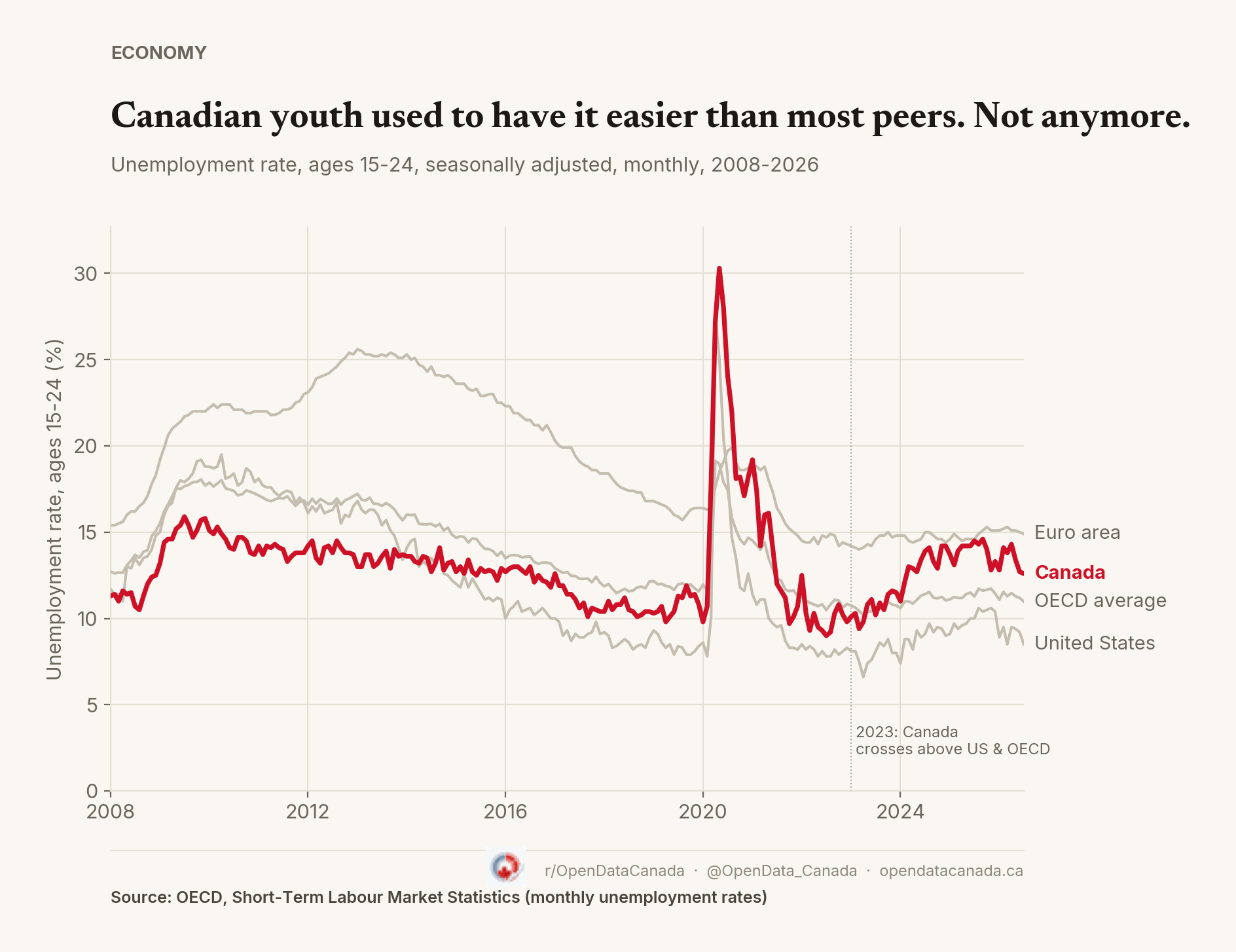
The AI Red Herring vs Macroeconomic Stagnation
For the past three years, headlines and tech executives insisted that automation was wiping out junior white-collar work. If you spent months hunting for an entry-level analyst position, people told you an algorithm had taken your chair. Automation has changed plenty of office tasks, yet the StatCan findings show that technology is far from the main driver behind the hiring freeze.
If software were clearing out the bottom rungs, hiring would have collapsed in desk roles while hands-on work stayed steady. StatCan found the opposite pattern. Occupations that computers cannot perform, such as warehousing, culinary preparation, construction support, and personal physical services, saw the sharpest drop in youth hiring rates.
The slowdown comes down to basic macroeconomics: high borrowing costs, weak business investment, and a defensive corporate mindset that gripped Canadian employers in late 2023.
Much of the pressure goes back to the Bank of Canada. The central bank raised its benchmark rate aggressively to fight generational inflation, keeping borrowing costs high well into 2025 before making cautious cuts in 2026. For companies across Ontario, Alberta, and British Columbia, expensive debt meant postponing capital spending, paying higher carrying costs on credit lines, and protecting tight balance sheets. Under those conditions, businesses rarely pay to train new grads who need six to twelve months to reach full productivity. Employers choose to run lean, squeeze immediate output out of existing staff, and let natural attrition shrink the payroll.
As overall job vacancies sank to multi-year lows, the applicant pool at the entry level changed. Grads now compete directly against experienced workers who were caught in corporate downsizings and took junior positions just to stay employed.
Recent analyses of Canadian employer hiring freezes trace this trend across corporate Canada, where employers have relied on formal and informal hiring pauses. Once executives mandate that managers may only recruit for mission-critical seats, entry-level openings are the very first requisitions to be cancelled.
The Tech Exception: Why Junior Developers Face a Specific Squeeze
Even if AI is not dragging down the entire Canadian economy, StatCan’s data reveals an ugly picture for tech. Within occupations exposed to automated tools, hiring rates for entry-level coders dropped off a cliff.
A slide from 2.5 percent down to 1.9 percent is a punishing hit for early-career developers. Anyone looking for an entry-level software engineer position in Toronto, Vancouver, or Montreal has felt that crunch firsthand.
Two pressures hit the industry at the same time: a hangover from pandemic overhiring, and the rapid rollout of AI coding assistants.
Between 2020 and 2022, Canadian tech companies and global satellite offices went on a massive hiring binge, spurred on by zero-percent interest rates and speculative venture capital. When the market corrected, tech companies slashed costs and shed thousands of roles. Balance sheets stabilized in 2025 and 2026, but firms chose not to rebuild their old hiring structures.
Instead, engineering departments adopted automated code-generation tools, unit-test generators, and documentation copilots. From what we see working with job seekers across Canada, intermediate and senior developers can produce substantially more boilerplate code in a week than they could three years ago. The routine assignments companies once handed to junior developers, such as writing basic integration tests, building standard API endpoints, and refactoring simple modules, can now be handled by a senior engineer paired with an AI assistant in minutes.
That change broke the traditional tech apprenticeship pipeline. Companies that used to bring in cohorts of twenty junior developers every summer to train them up now hire five intermediate engineers who can supervise automated workflows. Classroom syntax and a few course assignments on GitHub do not cut it anymore. Teams want entry-level hires who understand systems architecture, security guardrails, and deployment pipelines from day one.
This structural change explains much of the broader AI skills gap in Canada. Employers turn junior candidates away because traditional computer science programs and bootcamps still train students for manual task execution, which Canadian corporate development teams have already phased out.
The following CTV News broadcast details how these economic contractions and hiring freezes have pushed youth unemployment rates to worrying levels across Canada.
The Generational Experience Trap
Every young Canadian job seeker recognizes the absurdity right away: an opening explicitly labeled “entry-level” that demands three to five years of experience.
That expectation is the blunt outcome of an employer-driven market. When a mid-sized logistics company in Mississauga or an engineering consultancy in Calgary posts an entry-level position and pulls in five hundred applications within seventy-two hours, the hiring team needs a quick way to filter the stack. Overwhelmed human screeners and applicant tracking systems simply raise the minimum criteria. When a hiring manager can interview a candidate who brings three years of demonstrable experience for the same $55,000 starting salary that would normally go to a fresh graduate, they take the experienced candidate every time. It eliminates training overhead and cuts down on hiring risk.
That leaves early-career workers caught in the classic trap: you cannot get a job without experience, but you cannot get experience without a job. For new grads across Canada, this cycle has dragged out the transition from school into a stable career by months, and often by years.
Meanwhile, older workers are staying in their jobs longer. With elevated mortgage rates, surging housing costs, and rising consumer price pressures, middle-aged and older professionals cannot afford to step away from the workforce or take early retirement. The natural upward movement through the corporate pyramid has stalled, leaving very few openings at the bottom for newcomers.
Federal and provincial agencies have tracked these disruptions through regional job banks and labour force updates. According to national trends documented on the Government of Canada Job Bank, entry-level vacancies have contracted far faster than intermediate and senior requisitions across nearly all administrative, operational, and commercial sectors.
Sector-by-Sector Breakdown: Where Early-Career Workers Face Hurdles
The hiring freeze does not hit every corner of the Canadian economy the same way. The headwinds in one field look completely different from the roadblocks in another, so you have to know what is actually stalling hiring in your target area.
Corporate Administration, Finance, and Office Operations
Junior roles in banking, insurance, payroll, and corporate administration are caught in a double squeeze. Companies watching costs have clamped down on non-revenue-generating headcounts. At the same time, business software has absorbed the clerical tasks entry-level staff used to handle, like data entry, ledger reconciliations, and document routing. Where new accounting clerks and administrative assistants once spent whole days organizing invoices, matching ledgers, and booking schedules, enterprise resource planning platforms run those workflows automatically. Finance and accounting teams now manage the same transaction volumes with far fewer junior staff.
Frontline Services, Retail, and Hospitality
Frontline service jobs were long the standard entry point for teenagers and young adults stepping into the workforce. StatCan recorded hiring rates in low-exposure occupations sliding from 4.0 percent down to 3.3 percent, and the shift is obvious on the ground. In cities like Vancouver, Toronto, and Montreal, hybrid schedules permanently cut into foot traffic. Downtown retail and dining hubs that used to rely on steady daily crowds now run with minimal staff through quiet mid-week shifts. On top of that, rapid population growth from international students and temporary foreign workers between 2022 and 2024 increased competition for minimum-wage positions, leaving fewer traditional summer and part-time jobs for domestic youth.
Skilled Trades and Heavy Industry
Canada talks constantly about its skilled trades shortage. Federal and provincial governments have spent tens of millions of dollars urging young Canadians to apprentice in plumbing, electrical work, carpentry, and welding. Yet candidates who finish pre-apprenticeship programs regularly hit a wall: finding a certified journeyperson willing to sponsor a first-year apprentice. Small trade contractors on tight margins often avoid taking on first-year apprentices who need constant oversight and bring in little billable revenue. As career resources like Alberta ALIS point out, getting started requires working around rigid apprenticeship ratios and regional project cycles, which is difficult without existing industry contacts.
Healthcare and Social Assistance
Healthcare is one of the few sectors in Canada with steady demand across the country. Provincial health authorities still recruit aggressively for licensed healthcare workers. For early-career workers without specialized, accredited healthcare degrees, however, entry-level roles in community health, hospital administration, and clinic support stay tied up in union seniority systems, slow credentialing, and prolonged hiring cycles.
Regional Realities: How the Freeze Varies by Province
Looking for work in downtown Toronto is nothing like hunting in Edmonton or Halifax. That national hiring rate drop to 3.3 percent plays out unevenly across provincial borders.
Ontario has felt youth unemployment acutely. With so many head offices in finance and technology clustered in the Greater Toronto Area, corporate entry-level freezes have hit local graduates hard. Between high housing costs and stalled corporate hiring, plenty of grads end up extending their studies or taking jobs outside their fields just to cover rent.
In Alberta and Saskatchewan, resource investment and municipal infrastructure spending have softened the blow. Hiring in Calgary and Edmonton has stayed relatively more active across energy, utilities, and commercial logistics. Even so, Prairie employers have leaned toward hiring experienced workers relocating from eastern provinces instead of training fresh local graduates.
Out in British Columbia, pullbacks in venture capital and visual effects production have squeezed early-career workers in creative tech and digital entertainment. Vancouver has grown risk-averse, with employers holding out for candidates who already bring direct, specialized production experience.
This is why provincial labour data matters so much. Digging into reports like the September 2026 Labour Force Survey lets you see which industries in your home province are actually adding staff, instead of letting a broad national average set your expectations.
Why the Spray-and-Pray Application Method Is Broken
With youth hiring down at 3.3 percent, the instinctive reaction for early-career Canadians is to treat the hunt as a numbers game. You set job board alerts, use browser extensions to churn out forty jobs a day, and blast thousands of identical applications across the country. It is an exhausting habit that yields zero interviews.
When you hit “Easy Apply” on a major job board, your resume drops into a digital repository alongside hundreds or thousands of identical files. Nobody has the time or appetite to read through seven hundred PDFs for an entry-level operational role. Instead, hiring managers run automated keyword queries, glance at the top ten candidates who bring 1 to 2 years of direct industry experience, and toss the rest.
If you send five hundred applications through public job portals and hear nothing back, the silence usually means a human being never laid eyes on your resume. Relying on sheer volume in a low-churn market just does not work.
Breaking through an entry-level hiring freeze requires a targeted career marketing campaign. That means skipping automated screening barriers entirely, getting in front of decision-makers directly, and framing your skills around the specific problems their team needs solved.
A Practical Tactical Guide for Early-Career Job Seekers
When corporate Canada pulls back on entry-level hiring, relying on job boards stops working. You have to change how you identify and pursue work. Here are five practical strategies Canadian job seekers can use right away:
-
Target Mid-Market and Small Regional Businesses Instead of Enterprise Brands Most new grads flood the portals of the big Canadian banks, major telecom providers, and global consulting firms. Those pipelines are backed up and campus programs have shrunk. Mid-sized companies with 50 to 250 employees offer far better odds. Employers in regional hubs like Kitchener-Waterloo, Red Deer, Kelowna, or Moncton frequently have real operational needs, but they lack dedicated HR teams to run wide campaigns. They rarely spend money on national job boards, relying instead on local business networks, industry associations, and direct contact. Approaching these businesses puts you in front of people who actually have time to review your profile.
-
Transform Your Resume From Academic Credentials to Proof of Execution Most early-career resumes lead with a degree, a course list, and basic retail tasks. In a sluggish market, that format gets ignored. Canadian screeners want to know you can handle tasks without constant direction. Rework your resume around measurable outcomes. For a capstone project, detail the exact problem, the software or tools used, the data analyzed, and the business impact. If you worked as a server, highlight your cash reconciliation accuracy, inventory management contributions, and customer conflict resolution metrics. If you need objective feedback on how your experience reads, book a professional resume assessment to ensure your positioning matches current Canadian screening standards.
-
Master the Art of Direct, Low-Friction Outreach Public postings show only a fraction of open work. Many team leads and operational managers sit on projects that need doing, yet lack executive approval to run a costly hiring campaign. Find these managers on professional networks. Send a short note requesting an eight-minute conversation about their operational priorities, or share an observation about a problem in their sector. Before reaching out, optimize your LinkedIn profile for Canadian recruiters so your headline, summary, and project links establish your credibility the moment they view your profile.
-
Build a Public Portfolio of Practical Problem Solving If you lack corporate experience, create your own evidence. For junior data analysis roles, go beyond listing SQL and Python on paper: publish an interactive dashboard analyzing open Canadian municipal transit data on GitHub. If you want marketing or sales roles, run a modest lead-generation campaign for a local non-profit or small business and document the conversion metrics. A hiring manager will readily overlook a thin corporate history if you hand them a project proving you can do the job on Monday morning.
-
Consider Contract and Staffing Agency Placements as Stepping Stones Many recent graduates skip contract, seasonal, or agency roles in search of permanent positions with benefits. But with permanent entry-level hiring rates down to 3.3 percent, temporary contracts offer a reliable path around corporate hiring freezes. Organizations that freeze permanent headcount often still have discretionary budgets for temporary staff. A six-month placement gets your foot inside a Canadian corporate environment, builds resume credibility, and connects you with internal managers who can hire you permanently once budgets open up. We cover the trade-offs of this route in our guide on staffing agency vs direct hire.
How to Manufacture Real-World Experience When Nobody Will Hire You
The objection we hear most from new grads is entirely fair: “How can I show proof of execution if no one gives me the chance to do the work?”
Waiting around for an employer to hand you that chance rarely works out. You have to build that early track record yourself.
Start by looking closely at small businesses, non-profits, or community associations down the street. Your neighbourhood pet shelter, an independent retailer, or a local youth sports league almost certainly wrestles with messy inventory spreadsheets, customer communications, awkward website accessibility, or digital marketing.
Pitch them something clear and small. An open-ended offer to help just gives a busy manager another chore, so propose a bounded project with a firm deadline. For instance: “I noticed your website lacks structured local search data, and your event calendar is outdated. I would like to spend the next two weeks rebuilding this landing page and setting up automated email confirmations for your donors at zero charge.”
Once you deliver, you have a genuine case study. Put it right under professional experience on your resume. You diagnosed an operational bottleneck, worked with a stakeholder, shipped a technical deliverable, and produced a measurable outcome.
It is also worth checking federally funded work placements and community initiatives on the Canada.ca Jobs Hub. Many Canadian non-profits and research institutes qualify for wage subsidies. That funding makes bringing on early-career workers viable, even while private sector hiring stays frozen.
Navigating the Psychological Toll of Career Delays
Hiring freezes take a real toll on your head, and pretending otherwise helps no one. Starting out in adult life across Canada right now means carrying significant student debt right alongside historic housing unaffordability and an unresponsive job market.
Months of silent rejection will wear down anyone’s self-worth. That sting feels sharper when your social media feed fills with peers celebrating new job offers, and you wonder why your degree has not produced anything similar. But those feeds are pure survivorship bias. People celebrate the one offer they accepted while burying the four hundred rejected applications that came before it. As the Statistics Canada study demonstrates, you are up against one of the tightest youth hiring markets our country has seen in decades.
To keep your sanity, separate your daily sense of accomplishment from whether an employer sent you an interview invitation. Corporate hiring budgets and macroeconomic interest rates sit entirely beyond your influence. What you can direct is your daily output:
- Did you do meaningful research on three target companies today?
- Did you send two thoughtful, personal outreach notes to team managers?
- Did you spend an hour sharpening a technical skill or building a portfolio asset?
- Did you step away from the computer to get some exercise and protect your mental well-being?
Treat the job search like a disciplined, professional project with set working hours. Draw firm boundaries: once your workday is over, close the laptop and leave it alone. Sustained, structured persistence across several months will outperform erratic, panicked bursts of resume blasting every single time.
What the Future Holds for Canadian Entry-Level Talent
Economic cycles do turn around eventually. The current market is rough, but Canadian demographics still point toward an opening down the road.
Canada’s baby boomer generation continues to retire in large numbers. Corporate restructuring and cautious budgets have temporarily stalled backfilling those roles, but that delay is widening an institutional knowledge gap across Canadian public institutions, healthcare networks, engineering firms, and industrial supply chains.
No business can operate with lean, senior-only teams forever. Without junior staff training up into intermediate specialists, employers will run straight into severe leadership shortages later on. The more forward-thinking Canadian companies already see that blanket hiring freezes just store up expensive institutional bottlenecks.
When macroeconomic conditions settle down and borrowing costs continue their gradual descent, corporate investment will follow. Once organizations restart entry-level hiring pipelines, they will seek out early-career workers who spent this slump building tangible skills, showing self-directed initiative, and getting comfortable with modern workplace tools.
The StatCan youth hiring study shows plainly that landing your first serious role in Canada today takes grit and deliberate strategy. Sending out a generic resume and waiting on an HR callback stopped working some time ago. If you understand the economic drivers behind the slowdown, focus on a clear target market, approach decision-makers directly, and show concrete proof of execution, you put yourself in a position to beat those 3.3 percent odds and build a resilient career foundation here.
Key takeaways
5
- Statistics Canada reported youth hiring rates fell across all occupations, with low artificial intelligence exposure roles dropping from 4.0 percent down to 3.3 percent.
- High borrowing costs and economic stagnation drove Canadian employers to retain experienced staff and halt junior hiring across hands-on and office roles.
- Entry-level software developer hiring fell from 2.5 percent to 1.9 percent as employers adopted coding assistants and cut back on junior training cohorts.
- Canadian job postings for entry-level positions demand multiple years of experience because high applicant volumes allow screeners to filter out recent graduates.
- Early-career candidates gain traction by contacting mid-sized regional employers directly and providing demonstrable project portfolios instead of using mass online applications.
Frequently asked questions
5
Why did youth hiring rates drop according to Statistics Canada?
Statistics Canada found that youth hiring rates dropped primarily because high borrowing costs and economic stagnation caused employers to freeze entry-level requisitions while retaining experienced personnel. Although public debate often blames automation, the steepest drop hit roles with minimal artificial intelligence exposure, such as warehousing, culinary preparation, and construction support. Canadian businesses adopted defensive spending habits, reducing training budgets for junior staff and allowing natural attrition to shrink payrolls rather than hiring and onboarding recent post-secondary graduates.
How did artificial intelligence affect junior tech hiring in Canada?
Artificial intelligence coding tools contributed to a drop in entry-level Canadian software developer hiring rates from 2.5 percent down to 1.9 percent. Engineering teams integrated automated testing tools and code generation software, enabling intermediate and senior developers to handle routine coding tasks that formerly went to junior apprentices. In addition to technology changes, tech firms faced a hangover from pandemic overhiring, leading Canadian companies to hire smaller numbers of intermediate engineers instead of running large entry-level training cohorts.
Why do Canadian entry-level job postings require years of experience?
Canadian entry-level postings demand three to five years of experience because corporate hiring pauses created massive candidate surpluses for few open vacancies. When a single job posting receives hundreds of applications within days, automated tracking systems and screeners raise filtering thresholds. Employers choose candidates who lost mid-level positions in corporate downsizings over recent graduates at identical entry-level wage rates, eliminating the costs associated with training new workers while minimizing workplace operational risk.
How can early-career Canadian workers bypass online applicant filters?
Early-career Canadian workers can bypass automated applicant filters by contacting hiring managers directly and targeting mid-sized businesses with 50 to 250 employees. Mid-market regional employers often have operational demands but lack large recruitment teams or budgets for national job board campaigns. Job seekers who send concise introductory messages to departmental supervisors, share relevant work portfolios, or pursue temporary staffing agency placements create direct routes into Canadian organizations that avoid crowded public job repositories.
How can new graduates demonstrate experience without previous employment?
New graduates can demonstrate experience by executing independent projects for local small businesses, non-profit groups, or community organizations. Proposing a defined assignment, such as fixing website data or resolving operational scheduling issues, creates verifiable outcomes that belong under professional experience on a resume. Job candidates can also build public portfolios displaying functional problem-solving skills, such as published data dashboards or marketing campaigns, or seek federally funded wage-subsidy placements listed on government job platforms.
Upcoming career fairs
Career fairs in Toronto
Listings are gathered each month from public event pages. Confirm the details with the organizer before you go.
More From the Blog
Upcoming Career Fairs in Quebec: November 2026 Dates, Venues and How to Prepare
Explore upcoming job fairs Quebec has scheduled this fall. Discover dates, venues, and practical preparation steps for 8 major hiring...
Read the articleNainly vs Simplify: Review and Comparison 2026
Comparing Nainly vs Simplify for Canadian job seekers: explore how a self-serve autofill extension contrasts with a done-for-you career...
Read the articleMicrosoft Offers Voluntary Buyouts for Tech Workers in Canada
Microsoft offered voluntary buyouts for tech workers in Canada. Here is how to evaluate severance, equity, and your next Canadian tech...
Read the articleReady to Launch Your Career Marketing Campaign?
Book a strategy call and see how Nainly can transform your job search.
Schedule a CallFree consultation. No commitment.